Rohingya Refugees: More Than 500 Asylum Seekers Feared Dead After Boats Vanish at Sea
Two overcrowded boats carrying an estimated 530 Rohingya refugees disappeared after leaving Myanmar’s Rakhine State, raising fears of one of the deadliest maritime tragedies this year.
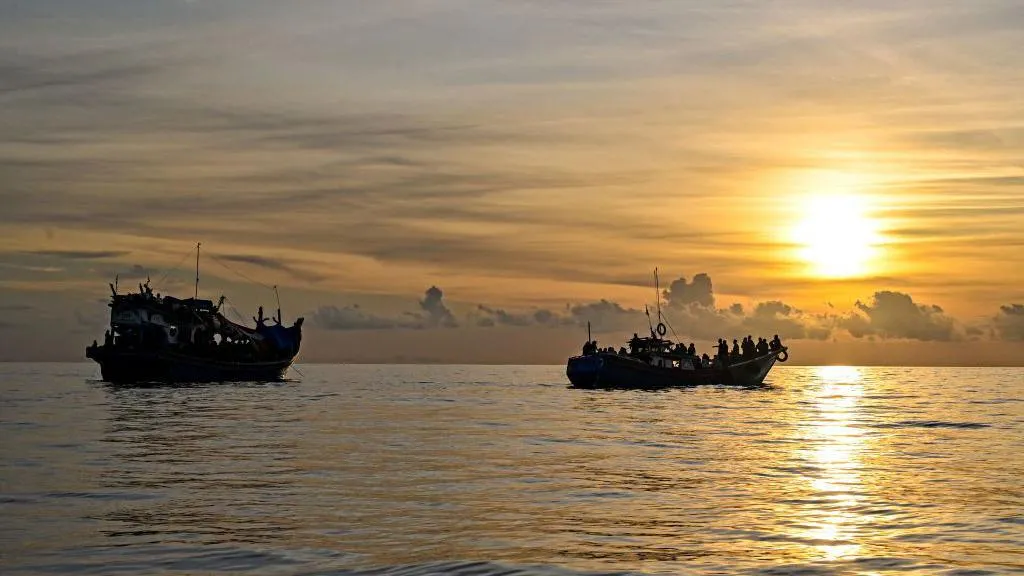
Overcrowded boats carrying Rohingya refugees before dangerous sea crossings in the Bay of Bengal.
YANGON: Rohingya refugees are feared to have suffered a devastating tragedy after two boats carrying an estimated 530 asylum seekers disappeared in the Bay of Bengal shortly after departing Myanmar’s Rakhine State on June 29, according to humanitarian groups.
The vessels, believed to be overcrowded fishing trawlers carrying men, women and children, have not been heard from for nearly three weeks. Aid workers fear both boats capsized during rough monsoon conditions, leaving little chance of survival.
Human rights campaigner Chris Lewa, director of the Arakan Project, said available evidence strongly suggests the boats left Sin Tet Maw on the same day before disappearing during their journey south.
Because conflict has severely disrupted communications across Rakhine State, investigators have struggled to confirm exactly what happened or determine whether anyone survived.
Authorities in Bangladesh have recovered the body of a woman believed to be from one of the missing boats, while fishermen along Myanmar’s southern coastline reportedly found several additional bodies days later. Those discoveries have strengthened fears that both vessels sank at sea.
The Rohingya continue to face worsening humanitarian conditions in Myanmar and neighbouring Bangladesh.
US-Iran Talks: Pakistan and China Urge Immediate Ceasefire and Return to Dialogue
More than one million Rohingya refugees live in overcrowded camps in Bangladesh, where employment opportunities remain extremely limited, humanitarian assistance continues to decline and criminal networks exploit vulnerable families.
An estimated 600,000 Rohingya remain inside Rakhine State, where ongoing fighting between Myanmar’s military and the Arakan Army has left many communities trapped in dangerous conditions.
Rights groups say both the military junta and armed groups have subjected Rohingya civilians to abuse, while forced recruitment, displacement and restricted movement have further deepened the humanitarian crisis.
With few legal pathways to safety, many Rohingya turn to people-smuggling networks that promise passage to Malaysia, home to one of the region’s largest Rohingya communities.
Smugglers typically transport refugees in overcrowded and poorly maintained boats before moving them through Thailand and onward to Malaysia. Families often pay around US$3,000 for the journey, while traffickers reportedly abuse those whose relatives cannot pay the demanded fees.
Human trafficking routes have evolved over the past decade as regional authorities increased enforcement, particularly after Thailand uncovered mass graves linked to trafficking camps in 2015.
Today, smugglers increasingly rely on larger vessels operating offshore and coordinate transfers using satellite communications before moving refugees through Thailand toward Malaysia.
According to Chris Lewa, at least 10,000 Rohingya have attempted dangerous sea crossings from Myanmar and Bangladesh since September last year, marking a significant increase driven by deteriorating living conditions and growing insecurity.
The United Nations has repeatedly urged governments in the region to establish safer migration pathways for Rohingya refugees. However, regional countries have largely refused to accept new arrivals, leaving thousands with few options beyond dangerous sea voyages.