Global AI: Xi Jinping Promotes China’s Open-Source Vision as Pakistan Joins WAICO
Chinese President Xi Jinping calls for a new global AI governance framework while Pakistan becomes a founding member of the World AI Cooperation Organisation.
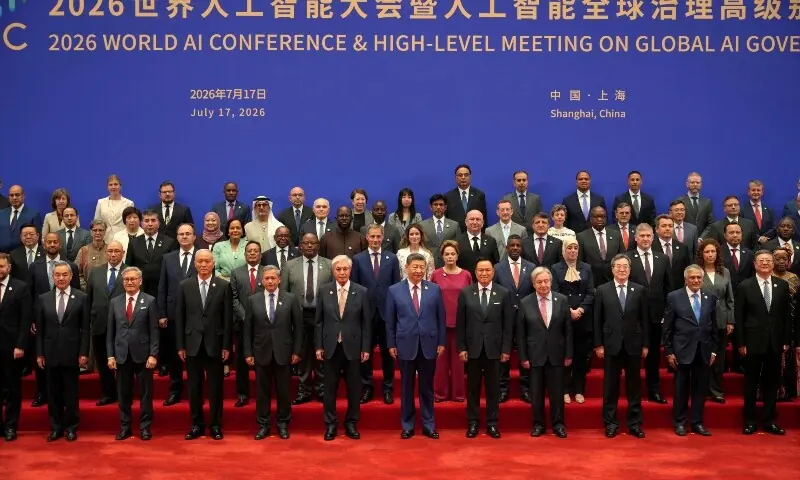
Chinese President Xi Jinping addresses delegates at the World Artificial Intelligence Conference in Shanghai.
SHANGHAI: Global AI governance took centre stage on Friday as Chinese President Xi Jinping presented China as a leader in shaping the future of artificial intelligence, promoting open-source technology and calling for broader international cooperation during the opening of the World Artificial Intelligence Conference (WAIC) in Shanghai.
Addressing delegates, Xi urged countries to seize what he described as a historic opportunity presented by open-source AI and pledged to help developing nations strengthen their artificial intelligence capabilities. He warned that unequal access to AI could create new forms of global inequality if governments failed to ensure fair participation.
Xi described artificial intelligence as a technological breakthrough comparable to the invention of the steam engine and electricity. He said China aims to share AI expertise with countries across the Global South while playing a leading role in developing international standards for the rapidly evolving technology.
Without directly mentioning the United States, Xi positioned China’s vision as an alternative model for global AI governance. His remarks came as Chinese open-weight AI models continue to challenge proprietary systems developed by major US companies, including OpenAI and Anthropic.
During the conference, Beijing-based startup Moonshot AI introduced Kimi K3, which the company described as the world’s largest open AI model by parameter count. The announcement followed recent changes in the United States involving advanced AI model access because of security concerns.
Xi also stressed the importance of keeping artificial intelligence under human control. He called on governments to establish early warning systems and emergency response mechanisms to manage AI-related risks and prevent autonomous systems from operating beyond human oversight.
The Chinese president highlighted the launch of the World AI Cooperation Organisation (WAICO), describing it as a major milestone in global AI development. The organisation signed up 29 founding member countries and aims to expand cooperation among developing nations on artificial intelligence research, governance and capacity building.
China also announced plans to provide AI training programmes and establish cooperation centres with BRICS, ASEAN, the African Union and countries across Latin America, reinforcing Beijing’s strategy of expanding technological partnerships throughout the Global South.
George Chen, Chair in Digital Practice at The Asia Group, said Xi’s message demonstrated China’s determination to lead both AI innovation and international AI standards rather than follow frameworks developed elsewhere.
The conference, running from July 17 to July 20, comes as Washington and Beijing prepare for their first government-level AI discussions under US President Donald Trump’s administration, making the Shanghai gathering an important platform for competing visions of global AI governance.
Pakistan Joins WAICO
Pakistan officially became a founding member of WAICO on Thursday after Deputy Prime Minister and Foreign Minister Ishaq Dar signed the agreement establishing the organisation during a ceremony in Shanghai.
According to Pakistan’s Foreign Office, the country joined the initiative to strengthen international cooperation on artificial intelligence while representing the interests of developing nations.
On Friday, Dar and the Pakistani delegation also attended the opening ceremony of the World Artificial Intelligence Conference.
The Foreign Office said Pakistan supports inclusive and equitable global AI governance, wider access to emerging technologies, stronger capacity-building initiatives for developing countries and greater international cooperation to bridge the digital divide while ensuring that the benefits of artificial intelligence are shared globally.