
Israel’s recognition of ‘Somaliland’ an act of ‘political aggression’, says Dar at OIC moot
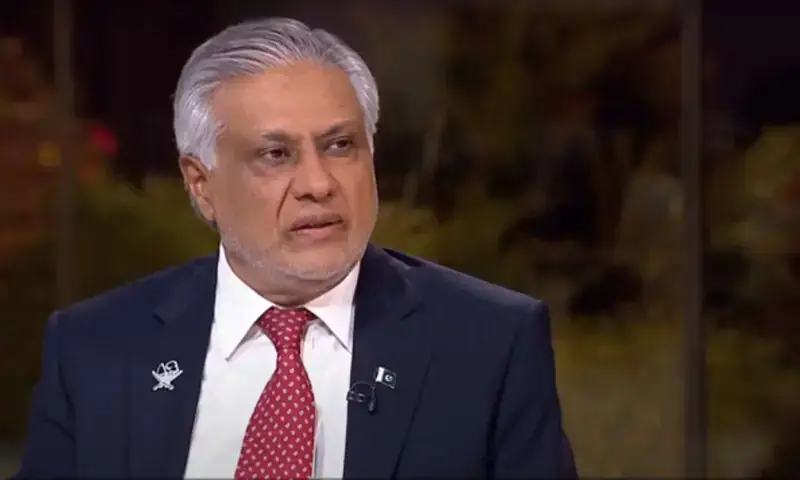
Deputy Prime Minister and Foreign Minister Ishaq Dar said on Sunday that Pakistan believed the recognition of the so-called “Somaliland” as an independent state by Israel was an act of “political aggression that sets a perilous precedent, threatening peace and security in the Horn of Africa, the Red Sea region, and beyond”.
Dar said this while addressing the extraordinary session of the Organisation of Islamic Cooperation’s Council of Foreign Ministers in Saudi Arabia.
His statement follows a joint statement by the OIC, which initiated its 22nd extraordinary session in Jeddah on Saturday. The moot has been convened against the backdrop of Israel recognising Somaliland as an independent and sovereign state, with Somaliland’s president, Abdirahman Mohamed Abdullahi, saying his state will join the Abraham Accords.
Later, Israeli Foreign Minister Gideon Saar visited Somaliland, condemned by Somalia as an “unauthorised incursion”.
Dar expressed Pakistan’s “unwavering support for the sovereignty, unity and territorial integrity of the Federal Republic of Somalia” in his address today.
“We strongly condemn the illegal and unlawful recognition by Israel of the Somaliland region of the Federal Republic of Somalia and the subsequent unwarranted and highly provocative visit of its foreign minister to Somaliland,” he said.
He added that Pakistan also voiced its firm support for Somalia and condemned Israel’s actions during the UN Security Council’s briefing on the issue.
“We identify this development as a direct assault on Somalia’s internationally recognised borders, which constitutes a flagrant violation of international law,” Dar said.
“The principle of state sovereignty and territorial integrity constitutes a peremptory norm of international law from which no deviation or derogation is permitted.”
Dar called the internationally-recognised borders of Somalia “sacrosanct and inviolable” and said that the Somaliland region remained an “integral, inseparable and inalienable part of Somalia”.
“No external actor has either the legal standing or the moral authority to alter that fundamental reality,” he said. “Any act, statement or recognition thereof by a state or an external entity regarding any part of the Federal Republic of Somalia should therefore be considered null and void, producing no political or legal effects.”
He added, “We believe that such recognition of an integral part of a sovereign state is not a diplomatic act, but an act of political aggression that sets a perilous precedent, threatening peace and security in the Horn of Africa, the Red Sea region, and beyond.”
The foreign minister added that Pakistan joined the group of OIC countries in “unequivocally rejecting the unlawful Israeli move” through the joint statement released in the immediate aftermath of the supposed Israeli recognition of Somaliland.
The joint statement termed the recognition of “parts of states” a violation of the cardinal principles of international law and the UN Charter and noted the Israeli action’s potential “serious repercussions” for the Horn of Africa region, the Red Sea region and for international security as a whole, he said.
“The OIC and the wider international community’s firm rejection of this unlawful overture by Israel is, therefore, vital so that the impudent Israeli act does not set a precedent for other countries,” Dar added.
He said that the developments in the region were “particularly alarming at a time when Somalia is demonstrating encouraging and tangible progress on its political and institutional trajectory”, pointing out that the Federal Republic of Somalia had made notable strides in national reconciliation, constitutional reform and the revitalisation of state institutions.
“Positive trends in the financial sector, particularly the efforts related to economic legislation and the move towards an inclusive one-person-one-vote election, represent important steps towards consolidating Somalian democracy and stability,” he added.
“These gains reflect a Somali-owned and Somali-led path towards political reconciliation and cooperation,” he said.
“This positive momentum must be protected and reinforced, not sabotaged and undermined by actions that risk fragmenting the country and reversing hard-earned progress across the entire milieu of national indicators.”
In addition, he said that Pakistan also recognised the sacrifices and resilience of the Somali people and its security forces in thwarting the consistent threat posed by Al-Shabab and its affiliates.
“Israel’s brazen recklessness undermines regional and international efforts aimed at combating terrorism in a region beset with this challenge.
“It also opens the door to the creation of fragile environments susceptible to infiltration and exploitation by extremist groups, thereby negatively impacting regional and global security,” the foreign minister said, adding that in this context, continued support for Somalia’s security and stabilisation efforts remained “indispensable”.
“At this pivotal juncture, when Somalia is focused on defeating extremism, any action that deflects attention, weakens cohesion or fuels division is profoundly irresponsible,” Dar said.
He said that Pakistan fully aligned itself with the OIC’s call “for all states and organisations to refrain from any form of formal, semi-formal, or informal engagement with the authorities of Somaliland”, and to ensure that any engagement strictly respected the sovereignty and unity of Somalia.
“Pakistan categorically rejects any proposal or plan aimed at the forced displacement of Palestinians and linkages of Somaliland region of Federal Republic of Somalia with any such illegal action,” he added.
“Any action that advocates or implies the displacement or relocation of Palestinians not only violates international law but also undermines the prospect of a just and lasting peace in the region.”
He reaffirmed Pakistan’s steadfast support for the Palestinian people in their legitimate struggle for self-determination, saying that the only path to lasting peace and stability lay in the realisation of an “independent, contiguous and sovereign” state of Palestine based on pre-1967 borders and with Al-Quds Al Sharif as its capital.
Dar added that as a “frontline supporter” of the UNSCR 2803 and the “Comprehensive Plan to End the Gaza Conflict”, Pakistan reiterated the intention to contribute to its successful implementation thereof, with a view to ensuring the sustainability of the ceasefire, bringing an end to the conflict in Gaza, to secure a “dignified life” for the Palestinian people who had endured prolonged humanitarian suffering, and leading to a credible pathway to Palestinian self-determination and statehood.
“As a non-permanent member of the UNSC, Pakistan will continue to work with the OIC and Arab partners to mobilise global support for the Palestinian right to self-determination, justice and peace,” he said.
On the topic of India-occupied Kashmir, the foreign minister said that the unresolved dispute remained the “primary source of conflict in South Asia and a nuclear flash point”.
He stressed the urgent need for renewed and concerted efforts under the UN auspices to secure a “just, lasting, and peaceful resolution of the dispute“, in accordance with the relevant UNSC resolutions and the aspirations of the Kashmiri people.
Dar also appreciated the “strong, unwavering and consistent support that the OIC has always afforded to our Kashmiri brothers and sisters”. Nevertheless, he urged the OIC to step up its efforts to support a just resolution of the dispute.
Dar called upon the OIC and the broader international community to “speak with one voice” and firmly reject all actions that undermined Somalia’s sovereignty and territorial integrity.
“This meeting today is a resounding manifestation of our collective solidarity with Somalia against a blatant transgression of its sovereignty by a decidedly unconscientious actor,” he said.
“On our part, Pakistan remains resolutely committed to standing with the government and people of Somalia as the country continues its advances towards continued peace and progress.”