
Shift from FTR to NTR will be reviewed in next federal budget: Aurangzeb
KARACHI: Federal Minister for Finance & Revenue Muhammad Aurangzeb announced that the shift from the Final Tax Regime (FTR) to the Normal Tax Regime (NTR) will be comprehensively reviewed in the next federal budget to safeguard Pakistan’s export base, particularly the textile sector which he described as the backbone of the country’s exports.
Speaking at a meeting during his visit to the Karachi Chamber of Commerce and Industry (KCCI) on Wednesday, the Finance Minister assured that the government fully recognizes the challenges faced by the export-oriented industries and will take corrective measures to strengthen Pakistan’s competitiveness in global markets.
Advisor to Finance Minister Khurram Shehzad, DG Tax Policy Office Dr. Najeeb Ahmed Memon, Chairman Businessmen Group (BMG) Zubair Motiwala, Vice Chairmen Anjum Nisar, Jawed Bilwani, Mian Abrar Ahmed and Tariq Yousuf, President KCCI Rehan Hanif, Senior Vice President Muhammad Raza, Vice President Muhammad Arif Lakhani, Chairman Federal Taxation Subcommittee Abu Bakar Siddique Ahmed Shamsi along with former Presidents and members of the Executive Committee were also present on the occasion.
Highlighting a major structural reform, the Finance Minister announced that the Tax Policy Office has been formally separated from the Federal Board of Revenue (FBR) and placed under the Finance Division, headed by Dr. Najeeb as Director General Tax Policy. He stated that the next year’s budget will not be prepared by the FBR but by the Tax Policy Office, ensuring that budget formulation is driven by economic value rather than mere fiscal arithmetic. The objective of this realignment, he explained, is to ensure continuity and consistency in fiscal policy, a long-standing demand of the business community. Frequent changes in taxation policy have eroded investor confidence, and by bringing tax policy under the Finance Division, the government aims to institutionalize stability and predictability in decision-making.
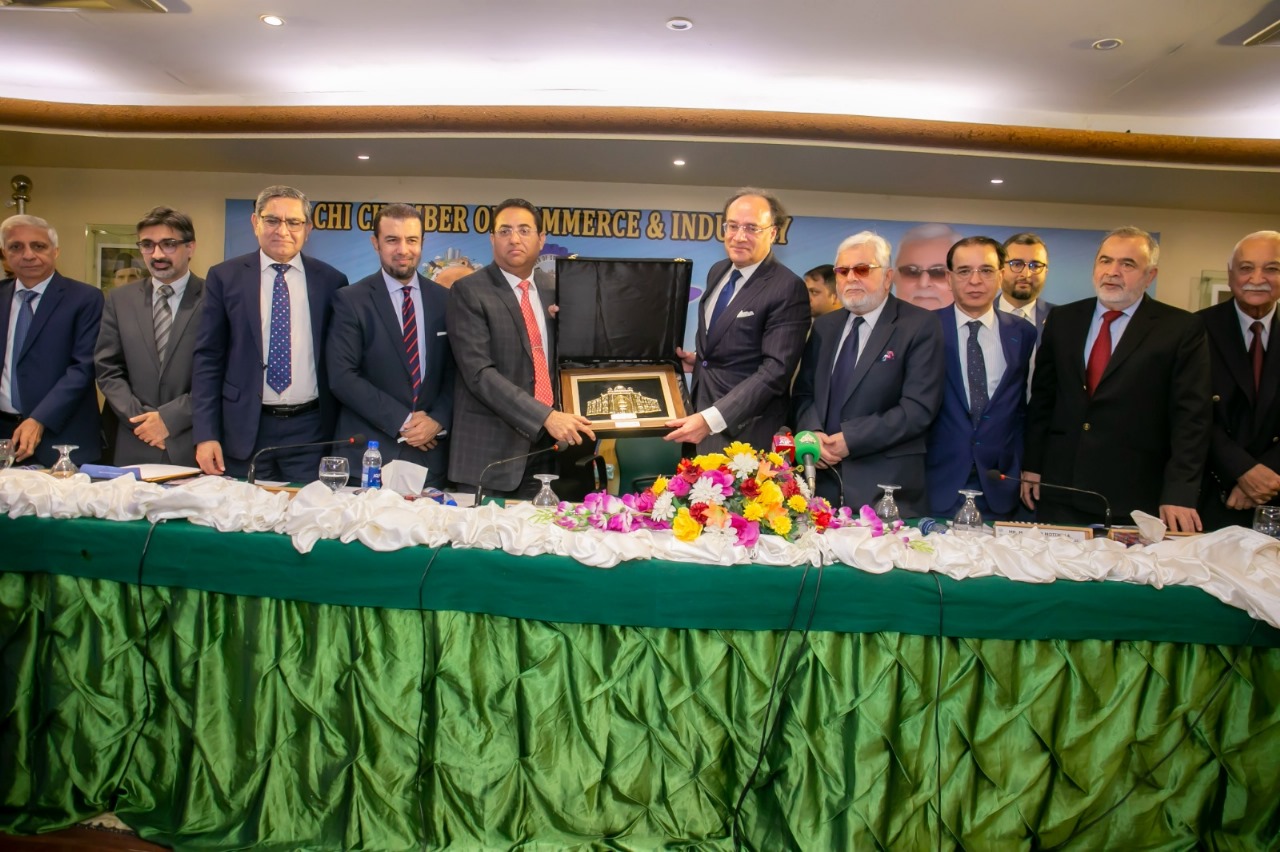
President Karachi Chamber of Commerce & Industry Muhammad Rehan Hanif presenting crest to Federal Minister for Finance & Revenue Muhammad Aurangzeb during his visit to KCCI on Wednesday. Advisor to Finance Minister Khurram Shehzad, DG Tax Policy Office Dr. Najeeb Ahmed Memon, Chairman Businessmen Group (BMG) Zubair Motiwala, Vice Chairmen Anjum Nisar, Jawed Bilwani, and Mian Abrar Ahmed, Senior Vice President Muhammad Raza, Vice President Muhammad Arif Lakhani and Former Vice President Haris Agar are also seen in the picture.
The Finance Minister further informed that Dr. Najeeb and his team will remain available round-the-clock for consultation with the business community, academia, and think tanks. He added that while it may not be possible to address every concern immediately in next budget, the process of consultation and reform will be ongoing and inclusive. “We want to move this country forward through a consultative approach”, he remarked.
He went on to share that the Prime Minister has constituted eight private-sector-led working groups, with no ministers included, to develop practical economic recommendations by November 30. The formation of these groups, he said, reflects the Prime Minister’s seriousness in taking input directly from the private sector. The Finance Minister also assured that Karachi Chamber will be included in these consultative groups, acknowledging the vital role of KCCI as the principal voice of the country’s business and industrial community.
Aurangzeb emphasized that every sector of the economy must contribute to exports, even if marginally, to enhance competitiveness. He noted that Pakistan’s automobile industry has recently succeeded in finding new export markets in the GCC and Africa, which demonstrates the potential of diversification. He said the government’s immediate priority is to reduce tariffs on industrial raw materials and intermediary goods to lower the cost of doing business and to revive industrial momentum.
Addressing concerns related to FATA and PATA, the Finance Minister clarified that income tax exemptions have been retained while a 10 percent sales tax was imposed this year after careful consideration, despite strong opposition.
Aurangzeb highlighted strong performance in various sectors, mentioning that IT exports reached 366 million dollars in September 2025 and are projected to surpass 4 billion dollars in the current fiscal year. He said the pharmaceutical industry has emerged as a rising star of Pakistan’s economy and assured that the government will continue to support its expansion. Despite losses in rice exports due to flood-related crop damage in Punjab, agricultural exports are expected to remain between 3 to 4 billion dollars. The Finance Minister also informed that the Reko Diq mining project is on track to achieve financial close by 2028, with first-year exports expected to reach 2.8 billion dollars, representing nearly 10 percent of Pakistan’s current export base.
Chairman BMG Zubair Motiwala, in his remarks, stated that whenever issues such as the shift from FTR to NTR or the burden of high gas prices are raised, the only justification provided is the IMF. “Show me one country that sells gas at a price higher than its cost”, he said, emphasizing that energy directly determines productivity. “If productivity becomes expensive, how can we compete when Bangladesh’s textile exports have reached US$46 billion while ours have declined from US$17 billion to US$16 billion?”
He noted that gas currently costs Rs1868 per mmbtu but is being sold at Rs3500, which is irrational. To address the circular debt issue, Motiwala stressed that only those responsible for creating circular debt should be penalized rather than imposing uniform penalties across all sectors. Highlighting that 47 percent of gas losses and theft occur in the domestic sector, he cited examples of Qatar and Abu Dhabi where, despite abundant gas resources, pipeline gas is not supplied to households; instead, domestic consumers use gas cylinders. “If Pakistan adopts the same model, circular debt can be easily managed”, he suggested.
Motiwala urged the government to negotiate with the IMF in a way that ensures Pakistan earns dollars through enhanced exports to repay its debts. Expressing concern, he said that it was disheartening that one million Pakistanis abroad remit US$38 billion annually while national exports remain stagnant at US$32 billion. He proposed that the business community be allowed to meet IMF officials to brief them on the ground realities and practical solutions for economic revival.
He further emphasized that by reducing duties on raw materials and aligning gas tariffs with regional competitors such as Bangladesh, Pakistan could easily raise an additional US$15 billion in exports within two years. “If we bring down our cost of doing business and energy tariffs to regional levels, we can significantly enhance exports,” he added.
Earlier, President KCCI Rehan Hanif, while welcoming the Finance Minister, said that when the Finance Minister assumed charge, the economy was in chaos and talk of default was widespread. Within a year and a half, the Finance Minister successfully restored stability, reflected in rising foreign exchange reserves, a record-high stock market, and upgraded credit ratings by international agencies. Owing to a stable exchange rate, remittances reached 38 billion dollars in FY 2024–25. “The situation has improved considerably, though it is still not ideal”, he remarked.
Highlighting key business concerns, Rehan Hanif said that due to the prevailing tax policy in FATA and PATA, industries such as tea and steel are shutting down. He also urged the government to review Section 7E of the tax law affecting real estate, warning that capital is increasingly flowing out to Dubai, and Portugal.
Commenting on e-invoicing, he said it is impractical in its current form. While large industries and multinationals may comply, small investors cannot. He suggested that the e-invoicing and e-bilty systems be reviewed and simplified. He further called for revisiting SRO 350 related and making the “edit” option in sales tax returns more user-friendly.
Expressing concern over stagnant exports, President KCCI remarked, “If it is our fault, then tell us.” He questioned why every issue is attributed to the IMF, observing that “whenever we approach any ministry, we are told the IMF does not allow it.” He said it seems government institutions use the IMF as an excuse for inaction.