

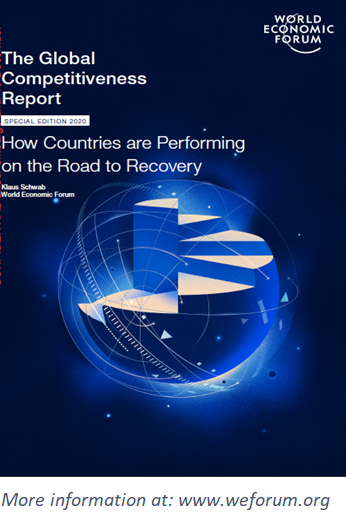
GENEVA – The World Economic Forum released the Global Competitiveness Report 2020 today. The long-standing Global Competitiveness Index (GCI) rankings have been paused. A special edition, published this year, elaborates on the priorities for recovery and revival, and considers the building blocks of a transformation towards new economic systems. The report assesses the features that helped countries be more effective in managing the pandemic and provides an analysis of which countries are best poised for an economic transformation towards systems that combine “productivity”, “people” and “planet” targets.
Almost one year after the onset of the COVID-19 crisis, the deep economic recession has triggered continues to have profound economic and social consequences. While no nation has emerged unscathed, this year’s Global Competitiveness Report finds that countries with advanced digital economies and digital skills, robust social safety nets and previous experience dealing with epidemics have better managed the impact of the pandemic on their economies and citizens.
“The World Economic Forum has long encouraged policymakers to broaden their focus beyond short-term growth to long-term prosperity. This Report makes clear the priorities for making economies more productive, sustainable, and inclusive as we emerge from the crisis. The stakes for transforming our economic systems simply could not be higher,” said Klaus Schwab, Founder and Executive Chairman of the World Economic Forum.
Amir Jahangir, Chief Executive Officer of Mishal Pakistan and the Country Partner Institute of the Future of Economic Progress System Initiative, World Economic Forum, said, “The success stories from Pakistan in the light of the Global Competitiveness Index 2020 is the performance and strengthening of the institutions, scaleup of digitization both at the public and private sectors.
“the surge for online services and data has increased more than 200 times in CoVID19 (Coronavirus) time period, both at the domestic and international level. CoVID19 has locked down communities and businesses into isolated environments, making the entire world go into Digital Incubation Ecosystems. The work from home has led to an increase in all levels of digital consumption across all stratas of the society. The Pakistani businesses have been forced to deploy digital solutions across all segments of the society including, Education, Business Processing, Services, and non-manufacturing etc. He further said, The Government needs to devise a system to use digital technologies for the welfare of the people. Also, tax regimes on technologies that help fight COVID-19 and contribute to data generation should be revisited to create more value for the citizens.”
The Report identified factors that registered the most negative for emerging and developing economies as Pakistan are the Business costs of crime and violence, Judicial independence, Organized Crime, Extent of market dominance and public trust in politicians. The Report identifies factors that registered the most positive shifts for emerging and developing countries are Government’s responsiveness to change, Efficiency of train services, Venture capital availability, country capacity to attract talent and collaboration within a company.
In recognition of the extraordinary developments in 2020 and of the unified global effort required to tackle the health crisis and its socioeconomic fallout, the Global Competitiveness Index rankings have been suspended for 2020. The 2021 edition will see a return to benchmarking, providing a refreshed framework to guide future economic growth.
The report reveals that countries like Netherlands, New Zealand, Switzerland, Estonia, and the United States with advanced digital economies and digital skills have been more successful at keeping their economies running while their citizens worked from home. These countries have performed well on this measure.
In advanced economies, business leaders saw increased market concentration, a marked decline in competition for services, reduced collaboration between companies and fewer available skilled workers in the employment market as the shift to digitally enabled work accelerated. On the positive side, leaders saw greater government response to change, improved collaboration within companies and increased availability of venture capital.
In emerging markets and developing economies, business leaders noted an increase in business costs related to crime and violence, a reduction in judicial independence, a further reduction in competition and growing market dominance, and stagnating trust in politicians. They, too, expressed positive views on government response to change, collaboration within companies, and venture capital availability. They also noted an increase in the capacity to attract talent, potentially facilitated by the more digital labor market.
“During this time of profound uncertainty, the health crisis and economic downturn have forced a fundamental rethink of growth and its relationship to outcomes for people and planet. Policy-makers have a remarkable opportunity to seize this moment and shape new economic systems that are highly productive while growing shared prosperity and environmental sustainability,” said Saadia Zahidi, Managing Director, World Economic Forum.
Key insights:
· Digital infrastructure investments: The transition to a greener and more inclusive economy must be underpinned by significant investments in infrastructure, including an expansion of digital networks. Denmark, Estonia, Finland and the Netherlands are currently best prepared to do this.
· Greener economy: Greening the economy will require upgrading energy infrastructure, transport networks and commitments from both the public and private sectors to extend and respect multilateral agreements on environmental protection. Denmark, Estonia, Finland and the Netherlands are best prepared to drive economic transformation through infrastructure. Less prepared countries include Russia, Indonesia, Turkey and South Africa.
· Longer-term investments: Increasing incentives to direct financial resources towards long-term investments in the real economy can strengthen stability and expand inclusion. Finland, Sweden, New Zealand and Austria are relatively better prepared than other advanced economies, while the United States, currently the largest financial centre in the world, is among the least ready.
· More progressive taxation: Shifting to more progressive taxation systems emerges as a key driver of economic transformation. On this measure, the Republic of Korea, Japan, Australia, and South Africa score highest, thanks to relatively well-balanced and progressive tax structures.
· Expanded public services: Future-ready education, labour laws and income support should be better integrated to expand the social protection floor. Germany, Denmark, Switzerland, and the United Kingdom are relatively better prepared than others to combine adequate labour protection with new safety net models. South Africa, India, Greece, and Turkey are less prepared.
The concepts of economic transformation are relatively new, and data is limited. Data from 37 countries was mapped against the 11 priorities outlined in the report and found that while no country is fully prepared for recovery and economic transformation, some are better placed than others. The report estimates that a 10% increase in readiness scores could lead to a $300 billion increase in the GDP figures of these 37 countries combined.
The report considers pathways for revival and transformation in four areas: the enabling environment, human capital, markets, and innovation. The report advocates a gradual transition from furlough schemes to a combination of proactive investments in new labor market opportunities, a scaling-up of reskilling and upskilling programmes, and safety nets to help drive the recovery. In the longer term, leaders should work to update education curricula, reform labor laws, and improve the use of new talent-management technologies.
While financial systems have become significantly more stable since the last financial crisis, they need to be more inclusive, and growing market concentration and raising barriers to the movement of goods and people risk hampering the transformation of markets. The report recommends introducing financial incentives for companies to engage in sustainable and inclusive investments, while updating competition and anti-trust frameworks. Although entrepreneurial culture has flourished in the past decade, the creation of new firms, breakthrough technologies and products and services that deploy these technologies has stalled. The report recommends that countries expand public investment in R&D while encouraging it in the private sector. In the longer term, countries should support the creation of “markets of tomorrow” and motivate firms to embrace diversity to enhance creativity and market relevance.
Over the next year, the World Economic Forum will be hosting a series of communities and dialogues to develop new benchmarks, new standards, and new actions for building new economic models that combine productivity, sustainability, and shared prosperity. The Global Future Council on New Agenda for Fiscal and Monetary Policy, the Global Future Council on New Agenda for Economic Growth and Recovery, the Community of Chief Economists, the Champions for a New Dashboard for the New Economy and the Stewardship Board of the New Economy and Society Platform will be involved in shaping this effort. All readers are invited to share their views into this conversation, supporting collective efforts to “build back better”.
The Global Competitiveness Reportis the flagship publication of the World Economic Forum’s Platform for Shaping the Future of the New Economy and Society. The Platform provides the opportunity to advancing prosperous, inclusive, and equitable economies and societies. It focuses on co-creating a new vision in three interconnected areas: growth and competitiveness; education, skills, and work; and equality and inclusion. Working together, stakeholders deepen their understanding of complex issues, shape new models and standards, and drive scalable, collaborative action for systemic change.
Over 100 of the world’s leading companies and 100 international, civil society and academic organizations currently work through the Platform to promote new approaches to competitiveness in the Fourth Industrial Revolution economy; deploy education and skills for tomorrow’s workforce; build a new pro-worker and pro-business agenda for jobs; and integrate equality and inclusion into the new economy, aiming to reach 1 billion people with improved economic opportunities.
Mishal Pakistan is Pakistan’s leading strategic communication and design company. It is also the country Partner Institute of the Future of Economic Progress System Initiative, World Economic Forum. Mishal is responsible to generate primary data on more than 100 indicators measuring Pakistan’s competitiveness. Mishal’s foremost domain of activity is behavior change communication, strategic communication with a spotlight on media and perception management.