

1. Introduction
Today, in Kuala Lumpur, Malaysia, the United States and India signed a landmark ten-year Defense Framework Agreement between U.S. Secretary of Defense Pete Hegseth and Indian Defense Minister Rajnath Singh [1].
This new pact calls for an academic analysis of what the word ‘framework’ signifies within defense diplomacy, its implications for Pakistan, how India’s continued imports of Russian oil affect regional alignments, and finally, how the Indian and Pakistani diaspora can bridge gaps to prevent hostility.
2. The Meaning of “Framework” in the U.S.–India Deal
In diplomatic and defense terminology, a framework refers to a broad institutional and policy structure that defines the direction, principles, and mechanisms for cooperation without specifying immediate transactions or weapons acquisitions. The U.S.–India
Defense Framework includes:
1. A Ten-Year Horizon: It offers a clear timeframe for both sides to coordinate joint military exercises, interoperability, and strategic planning [2].
2. Guiding Principles: It aims to “advance our defense partnership as a cornerstone for regional stability and deterrence,” emphasizing information-sharing, logistics, and co-development of technologies [3].
3. Operational Scope: The framework envisions enhanced coordination in maritime security, space, cyber defense, and supply chain resilience [4].
4. Flexibility: Its design enables adaptation to new geopolitical realities—such as China’s Indo-Pacific presence or emerging military technologies—over the next decade [5].
Thus, the word framework in this agreement refers to a strategic structure that formalizes cooperation, providing policy continuity without restricting future operational flexibility.
3. Implications for Pakistan
While not directly aimed at Pakistan, the agreement has both immediate and indirect effects on Islamabad’s security considerations.
Direct Effects
• The agreement improves India’s access to U.S. technology, training, and intelligence, potentially shifting the traditional power balance in South Asia [6].
• India’s increased military interoperability with the U.S. can reinforce its deterrence posture along Pakistan’s western and northern fronts.
Indirect Effects
• Pakistan may see this as Washington’s long-term tilt toward India, particularly within the Indo-Pacific strategy. This might lead Pakistan to strengthen strategic ties with China, Turkey, or Russia [7].
• The framework also sidelines Pakistan’s role in wider Indo-Pacific discussions, requiring renewed diplomatic efforts to stay relevant in the regional security framework.
Therefore, Pakistan faces the twin challenges of strategic isolation and the need for innovative diplomacy to avoid an imbalance in South Asia.
4. India’s Russian Oil Imports and Regional Dynamics
India’s ongoing import of discounted Russian crude adds a vital layer to this strategic puzzle.
• Russia supplied approximately 1.76 million barrels per day, accounting for 36 percent of India’s total crude imports in FY 2024–25 [8].
• Following new U.S. sanctions on Rosneft and Lukoil, Indian refiners started reviewing or suspending contracts to prevent secondary sanctions [9].
• Nevertheless, India’s energy imports have strained its relations with Western allies and prompted new tariff pressures from Washington [10].
Strategic Implications:
• India aims to maintain energy security and strategic independence, managing Western alliances alongside Russian supplies.
• For Pakistan, this duality means India benefits from both Western military support and Russian energy influence, thereby complicating South Asia’s power dynamics.
• If India uses savings from cheap oil to modernize its defense imports or expand its reserves, its economic-military capacity will grow, indirectly affecting Pakistan’s defense posture.
Therefore, energy diplomacy and defense alignment could together reshape the regional balance, with India seeking multipolar influence and Pakistan requiring careful counter-diplomacy.
5. Diaspora Diplomacy: Building Bridges for Peace
The Pakistani and Indian diasporas, especially in the United States, United Kingdom, and Gulf states, can serve as Track II diplomats to reduce rivalry and foster understanding.
• Dialogue & Scholarship: Joint diaspora conferences, think-tank initiatives, and cultural events can transform national narratives from hostility to cooperation [11].
• Policy Advocacy: Diaspora leaders can encourage host governments—especially the U.S.—to implement inclusive South Asia policies that promote trilateral engagement among Pakistan, India, and the U.S.
• Economic Linkages: Business collaborations between Indian and Pakistani Americans in sectors like healthcare, real estate, and technology can strengthen mutual economic interests in regional peace.
• Media Influence: Diaspora intellectuals can counteract polarizing rhetoric by promoting fact-based analysis and encouraging academic engagement among youth from both communities.
In an age of increasing polarization, diaspora networks could become the most effective non-state actors in keeping balance and dialogue between two nuclear neighbors.
6. Conclusion
The U.S.–India Defense Framework signifies a strong formalization of Indo-U.S. strategic cooperation for the next decade.
While India solidifies its role as a key part of the Indo-Pacific strategy, Pakistan needs to reevaluate its diplomatic tactics to prevent marginalization.
India’s ongoing Russian oil imports highlight a hedging strategy—balancing U.S. and Russian partnerships to maintain maximum autonomy.
For lasting stability, both nations and their diasporas must understand that sustainable peace hinges on inclusive dialogue, not zero-sum alliances.
Academic diplomacy, people-to-people exchanges, and shared economic interests remain the most reliable antidotes to militarized regional competition.
References
1. Reuters. U.S. signs 10-year defence pact with India, Hegseth says. 31 Oct 2025. https://www.reuters.com/world/china/us-signs-10-year-defence-pact-with-india-hegseth-says-2025-10-31
2. NDTV. India, US sign landmark 10-year defence framework in Malaysia. 31 Oct 2025. https://www.ndtv.com/world-news/india-us-sign-landmark-10-year-defence-framework-in-malaysia-9549753
3. Reuters. Ibid.
4. Newsweek. US signs defense deal with China rival India. 31 Oct 2025. https://www.newsweek.com/us-signs-defense-deal-china-rival-india-10972257
5. NDTV. Ibid.
6. Reuters Defence Correspondent Analysis. India-U.S. pact to deepen interoperability and technology transfer. 2025.
7. Pakistan Policy Institute USA Brief. Strategic implications of Indo-U.S. defence cooperation. 2025.
8. Reuters. Russian oil drives OPEC share in India’s imports to a record low. 22 Apr 2025. https://www.reuters.com/business/energy/russian-oil-drives-opec-share-indias-imports-record-low-data-shows-2025-04-22
9. Reuters. Indian refiners review Russian oil contracts after U.S. sanctions. 23 Oct 2025. https://www.reuters.com/business/energy/indian-refiners-review-russian-oil-contracts-after-us-sanctions-source-says-2025-10-23
10. Australian Institute of International Affairs. US–India relationship on the brink: Trump, Modi and Russian oil. 2025. https://www.internationalaffairs.org.au/australianoutlook/us-india-relationship-on-brink-of-breakdown-trump-modi-and-russian-oil
11. Pakistan Policy Institute USA. Diaspora Diplomacy and Peacebuilding in South Asia. Policy Note, 2025.
About the Author
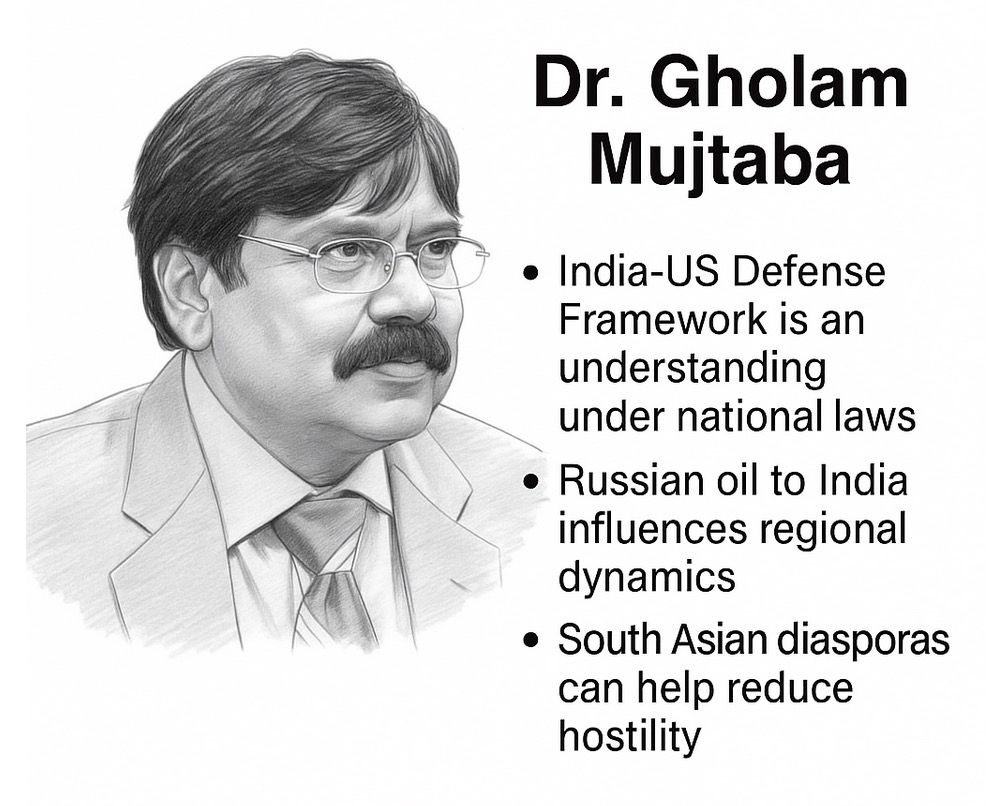
Dr. Gholam Mujtaba, MS, MD, Ed.D., FRSPH, is a Pakistani American scholar and Republican leader based in the United States. He chairs the Pakistan Policy Institute USA and writes about geopolitics, science policy, and U.S.–Pakistan relations.
He studied under the guidance of Nobel Laureate Prof. Sir John Vane (Medicine, 1982). He presented research with Nobel Laureate Sir Salvador Moncada at the 5th South Asian & Western Pacific Pharmacology Conference in Beijing (1988).
Dr. Mujtaba remains a committed Pakistani-American and an advocate for peaceful U.S.–Pakistan engagement within a pluralistic global order.