


Karachi : Dr. Qaiser Sajjad, Co-Convener of Karachi Citizen Forum and Secretary General of the Pakistan Medical Association, has said that there should be an apex body to oversee Karachi’s affairs, which should include representatives from all sectors. He said that the state of the city on August 19 left behind many questions. For years, floods have hit the city annually, troubling people, and yet the issue is forgotten soon after.
He was addressing a joint press conference on Monday at PMA House Karachi, alongside Forum Convener Nargis Rehman, retired Justice Shaikh Usmani, Muhammad Tauheed, PMA President Dr. Abdul Ghafoor Shoro, Mehnaz Rehman, and Mazhar Abbas.
Dr. Qaiser Sajjad said it is the responsibility of both the government and the public to protect citizens from hardships. “We are not here merely to criticize, but to seek solutions,” he said. “There must be someone responsible for Karachi, answerable for all the city’s affairs.”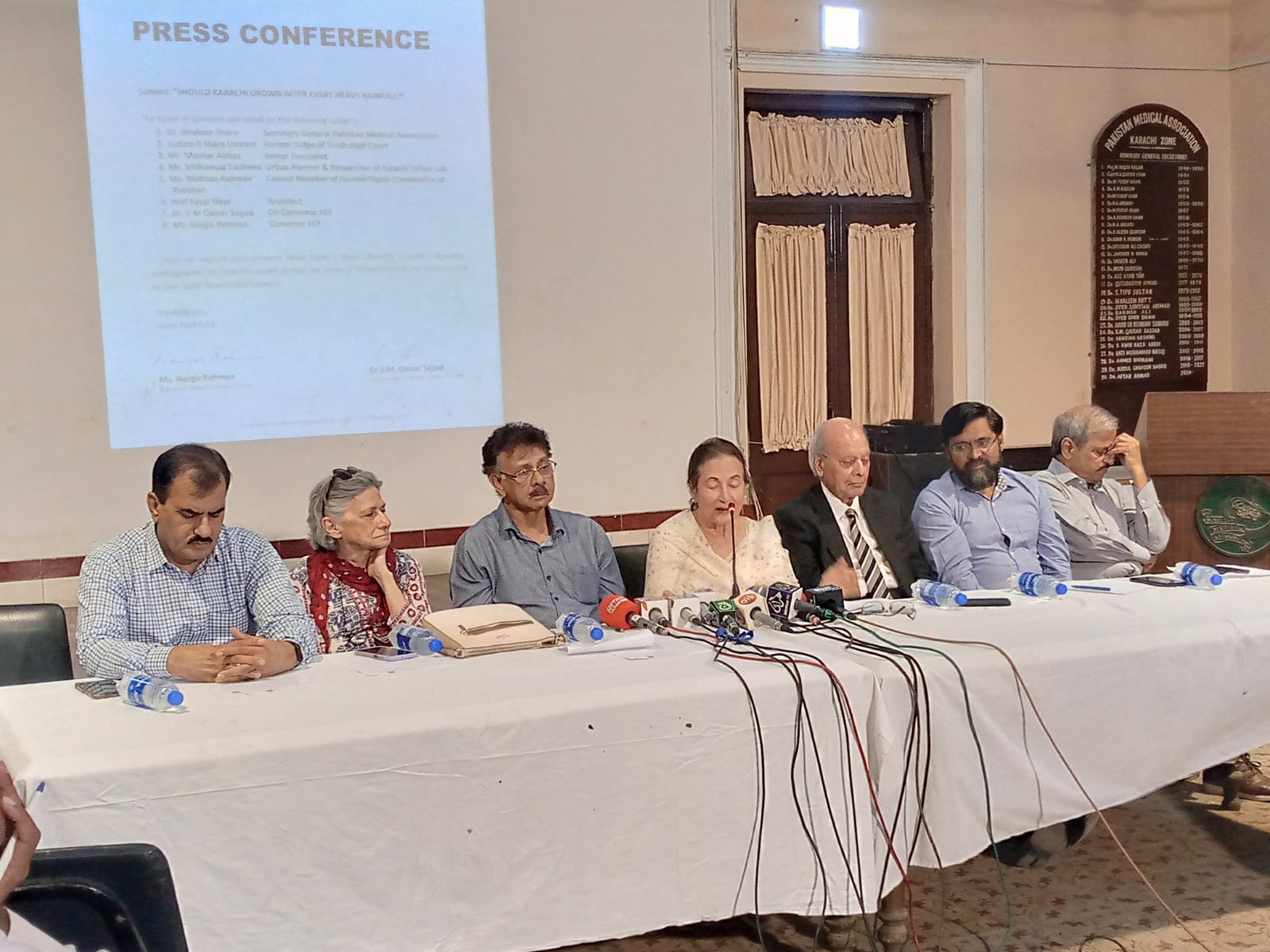
Nargis Rehman said that Pakistan and Karachi face abnormal levels of rains and floods, unlike anywhere else in the world. “Karachi was submerged, but it was the people themselves who saved the city,” she said, adding that warnings had already been given about rains and floods due to climate change.
Justice Shaikh Usmani (retd) said that he has seen Karachi since 1947. “Back when Pakistan was created, the city had an open drainage system, yet there were no such issues. Today, despite all the changes, Karachi still drowns – and this is alarming.” He stressed that Karachi needs good administration.
Dr. Abdul Ghafoor Shoro warned that after cloudbursts, there is also the danger of “disease bursts.” More illnesses may spread, worsening the situation. “Even now, diseases like diarrhea and typhoid are spreading, and it is unfortunate that rainwater is still stagnant in front of hospitals,” he said, adding that the PMA has always raised its voice and will continue to do so.
Mehnaz Rehman said that in such conditions, people lose their lives, with women and children being the most vulnerable to illnesses. She emphasized the need for clean drinking water and the elimination of encroachments.
Muhammad Tauheed highlighted that Karachi’s drainage system is faulty. “The sea lies at a higher level than Karachi, which causes problems. The 1996 government made the mistake of merging all stormwater drains into sewerage drains,” he said. Presently, the city has 38 major and 510 minor drains, and it is the duty of KMC and 25 towns to ensure their regular cleaning. He said that due to the Green Line Project, many drains had been blocked, worsening the problem. “Around 40% of the city’s garbage is dumped into drains. If drains are cleaned, such situations would never arise,” he said, adding that technology exists to bring improvements within a year. “In Lahore, the government has created a system that can store up to 3 million gallons of water at a time for reuse,” he pointed out.
Mazhar Abbas said that Karachi has always ignored its coastline. “Thousands of flats are being built on Sea View, which is in no way beneficial for the city. Institutions have become corrupt, and the city’s master plan is being mishandled just like encroachments,” he said. “I see no signs of improvement for this city.”