

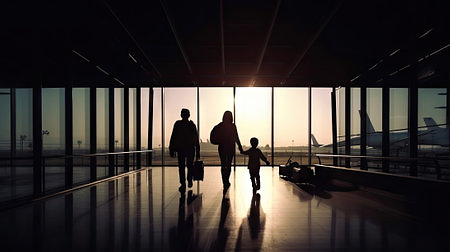
Every year, as airport terminals fill with tearful families and young faces clutching boarding passes, Pakistan quietly exports another shipment of its brightest dreams. We celebrate these moments, the scholarship letters, the visa approvals, the congratulatory dinners where relatives speak proudly of “a better future.” And rightly so. Ambition deserves applause. Opportunity deserves pursuit.
But beneath the surface of those glittering victories lies another story, a softer, quieter, more fragile one. A story that rarely makes it into policy papers or think-tank seminars. A story of aging parents left standing at departure gates long after the aircraft has disappeared, of siblings who learn to live with a room that will stay empty for years, and of the slow, quiet erosion of a family’s center of gravity.
We often frame going abroad as a linear equation: better education, better exposure, better earning potential. But life is not a spreadsheet, and human relationships do not fit into neat economic models. The trade-off is far more complex, and far more human.
I once met a father, a retired engineer from Lahore, who told me he keeps his son’s study table exactly the way it was on the night before he left for graduate school in Canada. “It helps,” he said, “when the house feels too large.” His son, now working in Toronto, sends money home every month. But money cannot sit with you at breakfast. It cannot notice the tremor in your hand that was not there the year before. It cannot ask, unprompted, “Abu, are you okay?”
This is the part of the story we rarely talk about.
For the student who leaves, the journey is not easy either, it is stitched with guilt, longing, and the emotional math of wondering whether your dreams are worth the price of absence. You study harder because you fear failure will make your sacrifices meaningless. You say “I’m fine” on calls not because you are fine, but because you don’t want your mother to worry across an ocean. You celebrate your first snow alone. You learn to pretend that loneliness is productivity. You teach yourself that distance is not abandonment, even when it feels uncomfortably close to it.
For many, migration is a triumph. For some, it is an escape. For almost everyone, it is a trade-off.
What complicates the story is that both sides love deeply, and both sides hurt quietly. Parents encourage their children to leave because they want them to experience a world bigger than the one, they inherited, even if it means shrinking their own world in the process. Children leave because they want to build something meaningful, even if it means missing the seasons of their parents’ lives.
We call this “brain drain,” an economic term that tries, inadequately, to capture an emotional reality. But the real drain is not only of talent; it is of presence, of companionship, of shared milestones. Weddings, funerals, illnesses, recoveries, life keeps happening while we are gone. And time, once lost, does not negotiate.
This OPED is not an argument against ambition, nor is it an emotional plea to stay home at the expense of growth. Rather, it is an invitation to rethink how we weigh opportunity. To ask whether a dream pursued alone is worth more than a life lived together. Whether success can feel complete when the people who prayed for it grow old in your absence. Whether progress, if it costs proximity, is still progress, or simply a different form of distance.
Maybe the real question is not whether students should go abroad, but whether we, as a society, have created a world where staying feels like stagnation. Maybe we need to build a Pakistan where talent does not feel compelled to leave, where opportunity is not outsourced, and where young people do not have to choose between their own future and their parents’ final years.
Until then, the trade-offs will remain painfully human.
Because behind every student leaving through an international terminal is a home adjusting to a quieter dinner table. A mother relearning how to pray for someone she cannot reach. A father was waiting for a phone call delayed by time zones. And a young person walking through immigration, brave, hopeful, uncertain, carrying the weight of two worlds: one they are entering, and one they are leaving behind.
And sometimes, the heaviest luggage is the love we cannot pack.