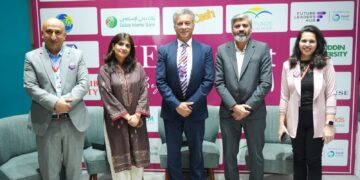


KARACHI, November 18, 2025: Standard Chartered Bank Pakistan and IFC, a member of the World Bank
Group, have announced a new $400 million Risk-Participation Facility to support short-term trade and
working capital facilities for major local corporates and exporters based in Pakistan, helping boost foreign
exchange inflows and drive sustainable economic growth.
“We are delighted to further solidify our enduring partnership with IFC through this groundbreaking
agreement – a unique collaboration between IFC and Standard Chartered Pakistan. As a bank with a strong
trade focus and a significant presence in 53 markets across Asia, Africa, and the Middle East, we are
instrumental in enhancing access to capital and liquidity and promoting global trade. This collaboration with
IFC empowers us to better support our clients, helping them expand their businesses and enhance their growth
potential,” Rehan Shaikh, CEO & Head of Coverage, Standard Chartered Pakistan, said.
"This new important milestone in our strong, longstanding partnership with Standard Chartered Bank Pakistan
reflects IFC’s deep commitment to strengthening Pakistan’s financial sector and supporting its export-driven
industries. By doubling the size of our Risk-Participation Facility, we are helping unlock vital trade and
working capital financing for businesses that drive growth, create jobs, and contribute to the country’s long-
term economic resilience. Together, we are advancing inclusive and sustainable development through
innovative financial solutions tailored to Pakistan’s evolving needs", Momina Aijazuddin, Regional Head of
Industry of IFC’s Financial Institutions Group for the Middle East, Türkiye, Central Asia, Pakistan, and
Afghanistan, commented.
This initiative, which was formalised in September 2025, builds on the previous joint $200 million facility
that was committed in December 2022. It capitalises on the extensive experience of IFC and Standard
Chartered in terms of export-oriented and large-scale manufacturing industries in Pakistan, and aims to boost
foreign exchange inflows. It is expected to drive sustainable economic growth in the country by enhancing the
availability of trade and working capital loan facilities, including supply chain financing and sustainable
finance products.


ADVERTISEMENT