

After devastating floods tore through the Hill Country on the Fourth of July, government representatives faced intense scrutiny about how they’ve handled the disaster, and whether earlier public warnings could have saved lives.
In response, President Donald Trump, Gov. Greg Abbott and other officials have pushed back against pointed questions and stayed mostly silent on what local leaders did during the crucial early morning hours before the Guadalupe River surged.
“It’s a masterclass in how not to communicate,” said Tom Stewart, a Texas public relations specialist who has worked in the past on storm response.
Professional crisis communicators like Stewart watched the news conferences with dismay. Deflecting blame is not helpful if politicians want to build trust with the public, they say.
“There’s no comms plan in the world that will take away the number of deaths and the pain of the families that lost children and relatives,” said Jeff Eller, another public relations veteran based in Austin. “What it can do is give comfort that the government cares, understands that there was a tragedy here and is making the resources available to make it better.”
Yet, “the more the questions came, the less credible they became,” Eller said.
Parents like Kristen Washam, a Hill Country native who now lives in the Houston area, intently listened to the official responses from day one. She didn’t like what she heard.
“People like myself, we want those in charge to be transparent, and it doesn’t seem like they’re being transparent. We’re getting a lot of deflection,” Washam said.
“It’s just frustrating,” she added. If children are going to continue attending the scores of summer camps along the river in the Texas Hill Country, parents need to know local officials are working to keep them safer in the future.

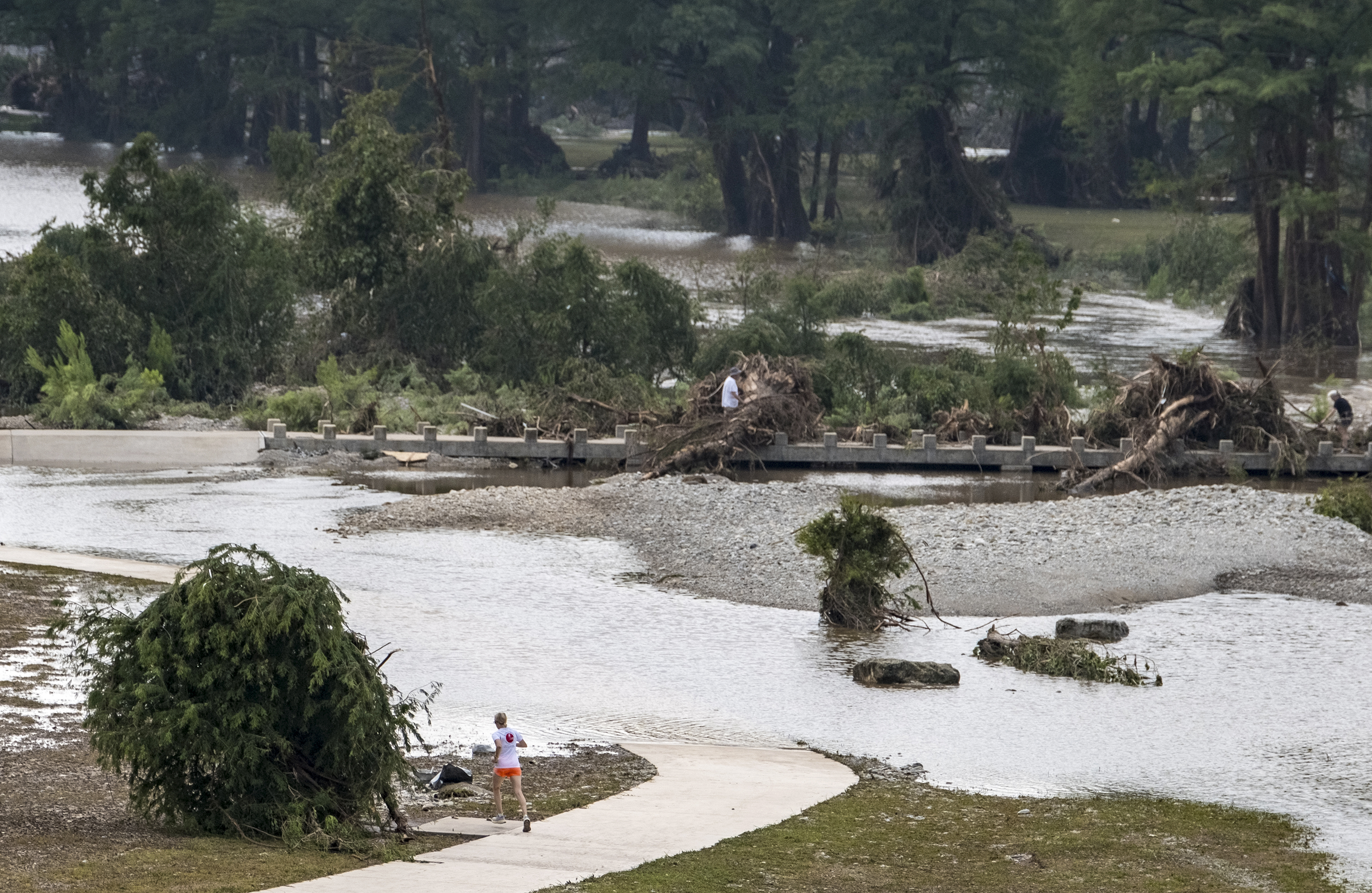
Humble resident, Darren Urie, center and wearing American flag shorts, crosses the Cade Loop bridge with his cousin as work crews clear and temporarily repair a bridge connecting Texas 39 to a residential area over the Guadalupe River in Ingram on Saturday July 5, 2025.
Asking about ‘blame’
When reporters asked last week who’s to blame for the tragedy, Abbott responded: “That’s the word choice of losers.” He then compared the situation to football.
“The losing teams are the ones that try to point out who’s to blame,” Abbott said. Winners are the ones who talk about solutions, he added.
Similarly, a reporter asked President Donald Trump, who visited Texas last week, about criticism from local families that warning alerts didn’t go out in time. The president responded: “Only a very evil person would ask a question like that.”
“I think everyone did an incredible job under the circumstances,” Trump said. Texas Rep. Chip Roy backed up the president, calling the reporter’s question “ridiculous.”
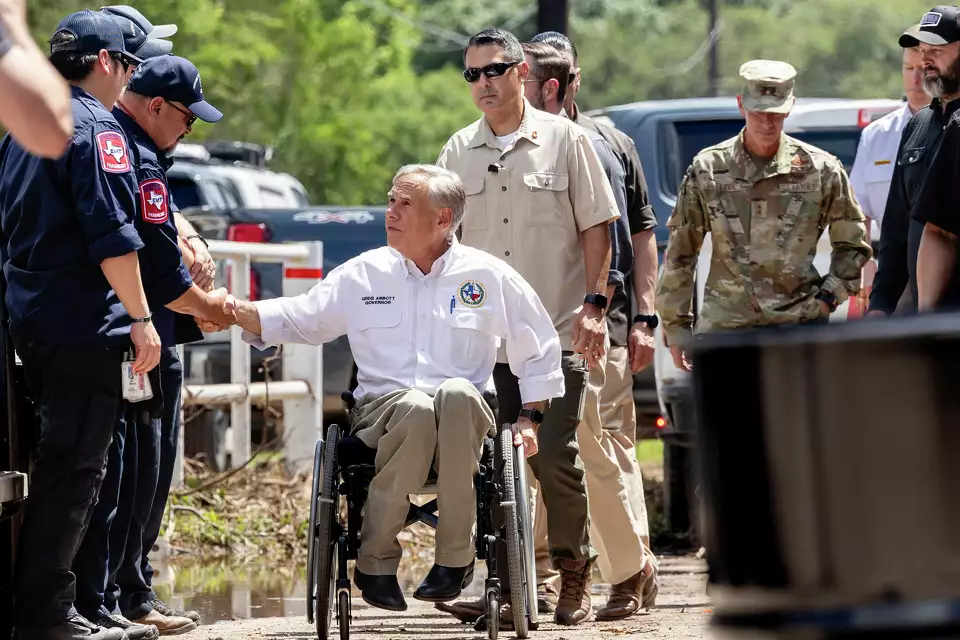
Governor Greg Abbott greets paramedics at The Hunt Store in Hunt, on Tuesday, July 8, 2025.
Josie Norris/San Antonio Express-News
Earlier last week, White House Press Secretary Karoline Leavitt said that blaming the Trump administration for the “once-in-a-generation natural disaster” was a “depraved lie,” in response to inquiries from congressional Democrats about National Weather Service vacancies.
“Many Democratic elected officials are trying to turn this into a political game. It is not. This is a national tragedy,” she said.
And, in a since-deleted post, state Rep. Brent Money, R-Greenville, said that there is “no universe where Texas House members have any responsibility for any aspect of this tragedy.”
“Anybody that says otherwise is a liar or a moron… or both,” he wrote.
Missing from the defensive comments, Dallas-based public relations professional Jo Trizila said, is empathy and humility in acknowledging that mistakes had to have been made somewhere for so many to have died, even if it’s not clear yet what went wrong or what could’ve been better.
“So far, we see people trying to blame somebody else. It just looks like a big cover-up. And I don’t think that’s what it is. I think nobody wants to admit that we failed,” Trizila said.
“What people want to hear is: ‘Hey, we screwed up. I’m sorry. We’re going to do better, and this is what we’re going to do, and these are the lessons we learned,’” she added.
SEARCH OUR MAP: Camp Mystic and others hit by deadly floods were built partly in ‘extremely hazardous’ flood zones
Stewart, one of the crisis communicators, said the public’s desire for answers and journalists’ questions were predictable. He thinks officials should lead with empathy, then offer factual accounts of what is known and what officials are doing.
“Be honest, be honest, be honest,” he said, while also staying consistent and feeding the information cycle.
“You’re in a crisis, you get that initial grace,” Stewart added, especially as overwhelmed local officials. But “when the serious follow-up questions start coming, you have to have a plan in place.”

Sam Owens/San Antonio Express-News
Unanswered questions
A day after the July Fourth floods, Abbott, Homeland Security Secretary Kristi Noem and other officials spent the first 20-plus minutes of a news conference discussing recovery resources that were deployed and congratulating each other for the rescue effort.
That sat poorly with San Antonio news anchor Stephania Jimenez, who slammed officials on-air.
“They spend way too long thanking each other,” she said.
The clip went viral on social media. Many local fans left comments thanking Jimenez for “speaking the truth” and “having the courage” to voice their thoughts.
Kerr County’s sheriff later avoided questions about what actions local officials took in the hours after the National Weather Service’s flood warning at 1:14 a.m. on July 4. He also declined to say if the county’s emergency manager was awake at the time.
More than a week after the floods, various media reports note that officials still have not provided much detail about what local officials did — or didn’t do — in the crucial few hours before the river rose.
Officials have said they’re still too focused on search-and-recovery work to address those questions.
“Right now, I don’t want to spend my time having to go back and look at timelines, because our focus is on the operation,” Kerrville city manager Dalton Rice told NBC News.

Christopher Lee/Staff Photographer
Eller, the Austin-based crisis communicator, said there’s been enough time since the initial recovery efforts to set up a “concerted communications effort to determine what happened, when it happened.” He pointed to the National Weather Service, which soon after the floods provided a clear list of what weather alerts it sent out and when, as a positive case study.
“I think you can push it off once and possibly twice, but I don’t think you should push it off more than that,” Eller said.
Los Angeles-based NBC News reporter Morgan Chesky, who was born and raised in Kerrville, saw both perspectives. The accountability questions are “absolutely valid,” he wrote in the Columbia Journalism Review, but he still felt “a little uncomfortable” as news conferences turned contentious.
“In a way, it felt like the story was shifting, or being taken out of the hands of the local people personally impacted, and shifting into a who’s-responsible, who’s-to-blame, who’s-at-fault situation,” Chesky wrote.
For their part, Texas state leaders say that officials’ focus right now must be on finding the missing and rebuilding damaged communities. But, in the coming year, the state legislature will be “looking at every aspect of this tragic event,” Lt. Gov. Dan Patrick and House Speaker Dustin Burrows promised in a joint statement.
“We will gather all the facts and answer the many questions to which the public demands answers,” they said.