

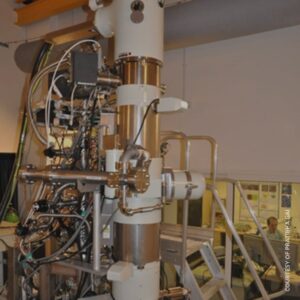
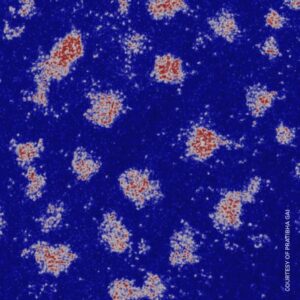
Pratibha Gai, a pioneering scientist originally from India, has achieved what once seemed impossible: she developed a microscope so advanced that it allows researchers to observe chemical reactions as they unfold at the atomic level.
Describing her field, Gai says working at such scale is “like looking at moving golf balls on the surface of the moon from the planet Earth.”
But her journey to becoming a world-leading scientist was far from predictable. Growing up in 1960s India, opportunities for women in science were extremely limited. That changed when a teacher handed her a book on Marie Curie, the first woman to win a Nobel Prize. Curie’s story, Gai says, was transformative.
“Here is a young lady who leaves her homeland, goes to another country for better educational opportunities and overcomes all the obstacles on the way and does something wonderful for humanity.”
Inspired, Gai set out to pursue a career in science. She later moved to the United Kingdom to continue her studies, eventually inventing an electron microscope capable of visualising chemical reactions in real time — a breakthrough that has reshaped modern materials science and chemistry.
Early in her career, Gai often faced gender bias. Her male colleagues were visibly surprised to see a woman working hands-on with scientific instruments. For her first research papers, she even published under her initials, “P.L. Gai”, after being advised that journals might reject work authored by a woman. Despite these obstacles, her research featured in leading scientific publications worldwide.
Today, Pratibha Gai is an Emeritus Professor of Chemistry at the University of York. Her groundbreaking microscope technology enables scientists to understand and manipulate chemical reactions at their source, paving the way for innovations in healthcare, clean energy, sustainable materials, food production, and environmental protection.
Despite the significant commercial value of her invention, Gai made a deliberate choice not to patent it.
“I’m not interested in making money from science,” she says. “I wanted other scientists to come up with more chemical inventions to help humanity.”
She continues to lead and inspire research focused on atomic-scale chemistry—work that is expected to drive scientific and technological progress for years to come.
The Life Scientific: https://bbc.in/47QaYS5