

Karachi— Pakistan strengthened its national digital-security agenda through three major initiatives held in Islamabad and Karachi— the Cyber Shield Policy announcement by the Ministry of IT & Telecommunication (MoIT), the Annual Cyber Security Conference 2025, and the PID Karachi Outreach Seminar on the Role of Artificial Intelligence in Combating Misinformation. Collectively, these events reflect the government’s proactive approach toward securing digital infrastructure, enhancing information governance, and empowering youth with the tools needed to navigate emerging cyber and media challenges.
In Islamabad, Federal Minister for IT & Telecommunication Shaza Fatima Khawaja formally highlighted the government’s newly launched Cyber Shield Policy, describing it as a “major milestone in Pakistan’s digital defence.” Speaking at an APP-covered national event titled “Cybersecurity, Cyber Shield Policy and the Future,” she explained that the policy provides comprehensive protection for e-governance systems, the financial sector, and health-related data. She emphasized that the policy marks a new era in Pakistan’s cybersecurity landscape by offering a unified security framework for both public and private institutions. Stressing the urgency of rapidly expanding digital threats, the minister said cybersecurity has become a matter of national security, adding that Pakistan can no longer afford to overlook digital vulnerabilities.
The minister also praised the Special Investment Facilitation Council (SIFC) for supporting the country’s digital initiatives and applauded Pakistani youth for defending Pakistan’s digital borders during recent conflicts, stating their skills have earned global recognition. She further highlighted the Digital Nation Pakistan initiative, noting that the Prime Minister is personally supervising the country’s digital transformation. She pointed to the launch of the National Artificial Intelligence Policy and ongoing government support for AI-driven companies as evidence of a strengthened national vision, adding that these reforms are creating new opportunities for young professionals while contributing to an increase in Pakistan’s IT exports.
Aligned with this national policy direction, the Annual Cyber Security Conference 2025, held at Serena Hotel in Islamabad and organized by EPL in collaboration with NADRA Technologies Limited, convened CEOs, CISOs, diplomats, technologists, and law-enforcement officials to discuss the country’s evolving threat landscape. Asad Shabbir, Assistant Director, Digital Communications Directorate (DCD), Ministry of Information & Broadcasting (MoIB), participated as a key panelist, highlighting Pakistan’s digital-communication vulnerabilities and the need for synchronized, real-time institutional responses. The conference emphasized enhanced cyber readiness, regulatory modernization, and resilience-building across public and private sectors, while international experts shared global best practices in combating cyber threats.
Speakers at the conference further stressed the importance of diversifying Pakistan’s cybersecurity workforce, including greater inclusion of women and youth to strengthen national capacity. Discussions centered on critical infrastructure security, financial-sector resilience, board-level cyber governance, and the rising influence of artificial intelligence in both attacking and defending digital systems. The conference concluded with a call for updated cyber laws, cross-sector collaboration, and continued investment in digital skills to ensure Pakistan’s long-term technological and economic security.
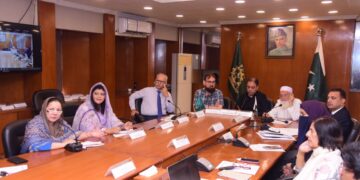
Simultaneously, Karachi hosted a high-impact outreach seminar at Iqra University, organized by the Press Information Department (PID) Karachi on “The Role of Artificial Intelligence in Combating Misinformation.” The event brought together DG PID Karachi Ms. Irum Tanweer, HOD Media Studies Mr. Rashid Shakir, Dean Dr. Wajiha Rizvi, and Mrs. Filza Rizwan, Manager PR & Events, alongside faculty and students. The session underscored the importance of government–academia collaboration in building digital literacy and strengthening society’s ability to counter misinformation in a rapidly evolving information environment.
The seminar began with a recitation and an institutional overview by Ms. Bakhtawer, Executive Officer PID, who discussed the role of PID and MoIB’s Digital Communications Directorate (DCD) in monitoring and countering misinformation. Information Officer Noor Ali delivered the keynote, explaining how AI-powered systems, fact-checking tools such as FactCheckerMOIB, and the Central Communication Cell (3C) model contribute to national information integrity. He referenced Pakistan’s narrative resilience during the May 2025 India–Pakistan conflict, characterizing it as “sixth-generation warfare where Pakistan won on all fronts,” supported by global perception indicators.
A dynamic Q&A session led by DG PID Karachi allowed students to explore AI ethics, digital responsibility, and communication risks in the modern era. Faculty and students praised the seminar for its practical relevance and expressed strong interest in future collaborations, research initiatives, and digital awareness programs. Together, the Cyber Shield Policy, the Annual Cyber Security Conference 2025, and the PID Karachi AI seminar demonstrate the Government of Pakistan’s commitment to protecting national digital space, strengthening cyber governance, and equipping the next generation with the tools to build a secure, ethical, and technologically resilient future.