

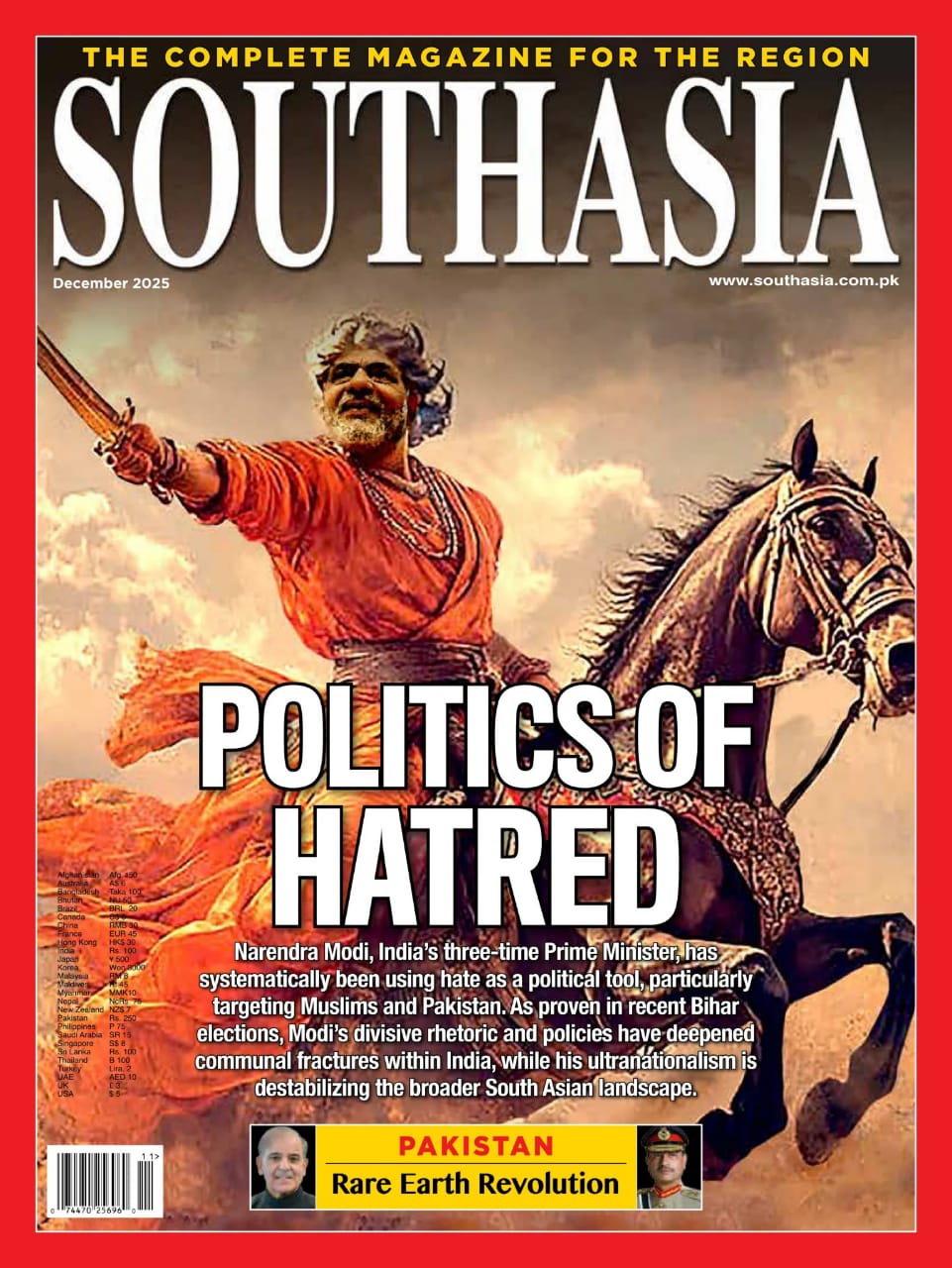
Karachi: Pakistan has the potential to emerge as a major supplier of Rare Earth Elements (REEs) and other Critical Materials essential to the global high-tech economy, provided the country commits to long-term strategic planning and strong political will. These views have been expressed by Professor Syed E. Hasan, PhD, Professor Emeritus at the University of Missouri, Kansas City, in an in-depth article published in the December 2025 issue of the US-award winning magazine SouthAsia. The article evaluates Pakistan’s primary and secondary sources of high-value technology metals and outlines how the country can position itself competitively in the rapidly evolving global mineral economy.
Prof. Hasan explains that nations around the world have expanded their focus in the past two decades on minerals categorized as Critical Materials because of their indispensable role in manufacturing high-tech devices. These include smartphones, semiconductor components, fiber optics, LED technologies, 5G infrastructure, advanced military hardware, electric vehicles, aerospace equipment, and renewable energy technologies. Many of these elements are scarce, difficult to extract, and vulnerable to geopolitical pressures. Their significance, he argues, now rivals — and may soon surpass — the role fossil fuels have historically played in global economic growth.
He notes that China currently controls 58 percent of known REE reserves, with Australia, Russia, and the United States holding most of the remaining share. Growing demand and concentrated supply have led to heightened volatility in global metal prices. The case of rhodium is particularly striking: during the 2008 financial crisis, its price surged to $354 per gram due to speculative trading, then dropped sharply to $15.64 per gram, only to rise again to $265 per gram by late 2025. Such instability, Prof. Hasan stresses, demonstrates why countries must secure their own supply chains for critical materials.
Pakistan’s potential in this regard lies not only in its geology — particularly in Gilgit-Baltistan and Balochistan, which are believed to host sizable REE deposits — but also in an unexpected secondary source: electronic waste. With an estimated 200 million mobile phone users in the country and an assumed device life of around ten years, nearly 20 million phones reach end-of-life annually. Even if half are refurbished or reused, roughly 10 million discarded phones still end up in landfills each year. These devices contain gold, platinum, palladium, indium, cobalt, copper, and various Rare Earth Elements. According to Prof. Hasan, this waste stream alone could yield over $2.2 billion worth of recoverable materials annually, representing one of Pakistan’s most overlooked economic opportunities.
He adds that 1,000 kilograms of discarded mobile phones contain significant quantities of high-value metals — including 270 grams of silver, 141 grams of gold, 18 grams of palladium, 10 grams of platinum, 53 kilograms of copper, and approximately 3.3 kilograms of REEs — valued at around $30,000 based on October 2025 prices. Smartphones contain even higher concentrations of valuable metals. With the explosive growth of digital device usage, this urban resource has become increasingly important not only for economic reasons but also for environmental sustainability.
Prof. Hasan also highlights the hidden value in mine tailings and industrial by-products across Pakistan. Historical examples show that materials once discarded as waste can become strategically valuable as technology evolves. He cites the case of beryl, a mineral found in pegmatite rock, which was initially ignored during mica mining but later became essential for nuclear technology, prompting commercial recovery from mine waste. Pakistan’s abandoned or historic mining areas, phosphate waste, coal ash, and industrial sludge may similarly contain recoverable quantities of REEs and should be systematically surveyed by the Geological Survey of Pakistan.
To capitalize on these opportunities, Prof. Hasan recommends establishing a centralized Critical Materials Campus capable of receiving, cataloguing, and processing e-waste and other secondary sources. Such a facility would require coordination among private industry, government agencies, financial institutions, informal recyclers, and academic institutions. Successful implementation, he emphasizes, will depend on transparent policies, long-term planning, and experienced management.
Prof. Hasan concludes that Pakistan stands at an important juncture. With natural geological endowment, a large and growing digital population, and vast unutilized secondary resources, the country has the raw potential to enter the global high-tech metals market in a meaningful way. “With modern exploration strategies, strategic vision, and decisive political will, Pakistan can secure a position in the global supply chain for critical materials,” he writes. “Doing so would open the door to unprecedented economic growth and technological advancement for the country.”
To read the full text of the article, log on to https://southasia.com.pk/2025/
Advertisements