

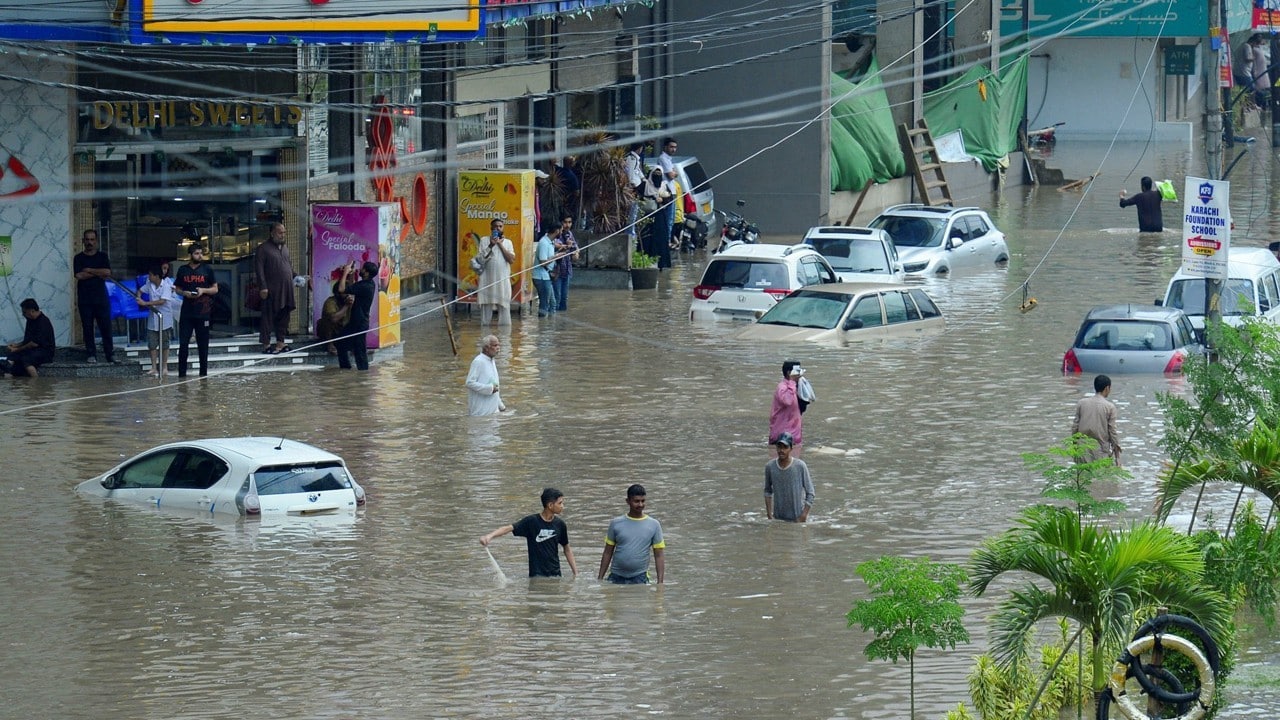
When heavy rains fall on Karachi and ruthlessly destroy infrastructure, severely damage homes, goods, and vehicles, and callously disrupt activities, then voices are raised once again against the insensitive neglect by lethargic public agencies, or apathy and lack of interest of Federal and Provincial governments, and the disinterest displayed by political parties and elders of the city.
All in all, all of them are sitting on a merry-go- round at a carnival, oblivious to the world. Extort as much revenue from Karachi and then blatantly forget about returning Karachi’s share to bring about change. Facile largire de alieno. In Latin, it means that it is easy to be generous with what is another’s. All this is pathetic or what?**
However, the real stakeholders of Karachi cannot claim genuine concern if they show apathy or complacency. In fact, Karachi’s stakeholders are not just residents of Karachi or those who venture into the city looking for employment or earning opportunities.
The stakeholders of Karachi are 180 million people known as Pakistanis living in this country or for that matter those who are the Pakistani Diaspora. The businessmen are standing at a precipice looking down at the gorge. Should they continue to do business in the city or move lock, stock and barrel to other Provinces or overseas?
The reason for the businessmen’s frustration, dejection, and exasperation is that it is Karachi that is the prime contributor to the nation’s Treasury and is the major source of meaningful employment, taxes, and foreign exchange. Karachi is also a two-port city as well as having the most literate population among all cities of Pakistan. Another tragedy is that there is still a quota system that prevails for decades despite the fact that it has a sunset clause of ten years. Hence, government jobs are mostly denied to Karachiites. Moreover, Pakistan is known because of Karachi and thus, net-net, Pakistan suffers if Karachi breaks down.
There are over 16,000 industries in organized sector employing more than 3 million workers and over 50,000 units in informal or unorganized sector or home-based employing another 2 million. Thus, Karachi provides employment for over 5 million workers. This excludes domestic workers or those working infrequently.
The Sindh Revenue Board collects nearly PKR 300 billion and Karachi’s share is 96% and another PKR 175 billion under Infrastructure Cess. K-Electric collects over PKR 3 billion from customers on behalf of Sindh Waste Management Board. Where does all this money go? The onslaught of indifference for Karachi has been further magnified by the continuous load-shedding of electricity, the low gas pressure, the erratic availability of water, the ballooning corruption in all tiers of the government ecosystem, and the landscaping of its beautiful environment has been despoiled due to scattered litter, heaps of stomach-churning garbage, and obnoxious graffiti nearly everywhere.
Karachi is a man-made traffic jungle. There are traffic laws and rules, but these are confined in the official documents and seldom applied on the roads. The only time a reference is made to these laws and rules is when a planned action is taken to enforce these. More often than not, these exercises fizzle out and vehicle drivers are back to the traditional practice of breaking of laws.
Despite efforts to introduce sanity on the roads, the obvious disconnect between the top Police hierarchy and policemen on the road is apparent. Blatant misuse of the orders by the Police traffic personnel is the norm. Turning a blind eye to the misdemeanor or violation is often possible once a quick deal is sealed between the regulator and the violator.
The continued political instability has been putting a heavy toll not only on Karachi’s economic picture, but also on the nation’s economic progress. At the same time, the effect on foreign investment in Karachi is also being impacted. The head of a multi-national bluntly stated that “foreign businessmen are now becoming reluctant to invest under the prevailing circumstances and the only option left for them is to check out other countries.”
Another declared in clear terms that the US investors have lost interest in funding projects due to civic disarray in Karachi. His colleague added “although foreign investment is not a panacea of all ills, yet the influx of foreign investment in Karachi’s industry, infra-structure development, and other sectors could help solve crucial issues.” A representative of a Japanese trading company stated that the Karachi problem has discouraged Japanese investors from coming here and that there “is a general feeling among the foreign investors that Karachi is no longer an ideal place to invest.”
Another Japanese moaned the circular debt when requested to invest in a power project. The Chinese also complain but cautiously. One Chinese businessman stated that “Karachi has both internal and external problems but no solutions. The investment environment is very bad.” Ominous words that further erode the image of this city.
The question being generally asked by one and all is “who owns Karachi?” but then no one is there to answer. Who says FATA is no-man’s land? Come to Karachi. Is it the domain of an ethnic party? Is it the responsibility of the provincial government? Is it a decreed Federal subject? Is it an abandoned orphan? Who does own Karachi? Do the 30 million denizens of this metropolis in the south own it? But then, who are its real denizens? Those who were born here or whose families migrated from their ancestral abodes in India after 1947 or those who come to seek their fortune in this city from the rest of Pakistan and then make their stay permanent, or those who are termed as undocumented immigrants, coming in from Afghanistan, Iran, Myanmar, or Bangladesh, etc.? Or even those whose elders are buried in Karachi’s graveyards? Even if ownership is not established, Karachi is Pakistan, and Karachi will always be Karachi.
“Living in this city, you developed a certain relationship with violence and news of violence: you expected it, dreaded it, and then when it happened, you worked hard to look away from it, because there was nothing you could do about it – not even grieve, because you knew that it would happen again and maybe in a way that was worse than before. Grieving is possible only when you know you have come to an end, when there is nothing more to follow. This city was full of bottled-up grief.” Author Bilal Tanweer in ‘The Scatter Here is Too Great’.
The writer is former President of Karachi Chamber of Commerce and Industry