


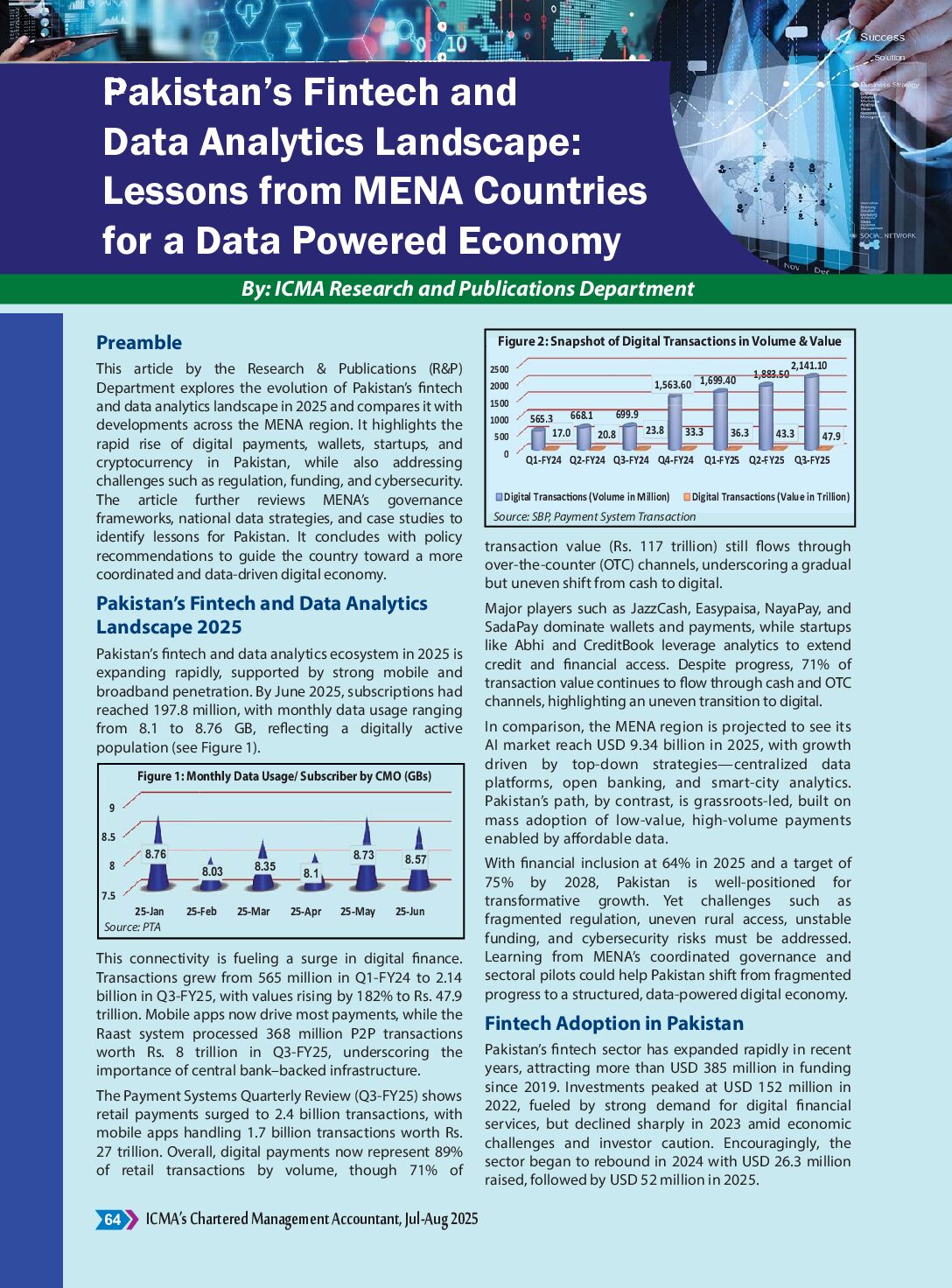
(Karachi – September 12, 2025): The Research and Publications Department of the Institute of Cost and Management Accountants of Pakistan (ICMA) has released new research calling for urgent policy action to accelerate Pakistan’s digital transformation. Drawing lessons from the Middle East and North Africa (MENA) region, including the UAE, Bahrain, and Morocco, the study recommends creating a National Data and AI Authority, introducing a mandatory open-data policy, and implementing a comprehensive open banking framework. These measures are seen as critical to unlocking fintech growth, strengthening investor confidence, and positioning Pakistan as a competitive player in the global digital economy.
The proposed National Data and AI Authority would provide unified oversight similar to models in the UAE and Bahrain. In the UAE, the National Data Strategy and Smart Dubai Office coordinate regulators, public agencies, and private companies to drive AI and data innovation. In Bahrain, the Personal Data Protection Law (PDPL) and the open-banking sandbox align financial regulators, government agencies, and fintechs to enable secure data sharing and innovation. In Pakistan, a National Data and AI Authority would bring together the National Information Technology Board (NITB), the National Centre of Artificial Intelligence (NCAI), and the National Centre for Big Data and Cloud Computing (NCBC), while complementing the recently established Pakistan Digital Authority (PDA). This coordinated structure would ensure consistent standards for data privacy and interoperability, strengthen governance, and build both investor and consumer confidence.
ICMA also recommends a mandatory open-data policy, following Morocco and the UAE, where machine-readable datasets are made publicly available through national portals. Making anonymized datasets accessible would fuel analytics-driven entrepreneurship, support startups and SMEs, and improve transparency in governance. Another key recommendation is a comprehensive open banking framework. Standardized APIs and a consent-based data-sharing system would allow consumers to manage their financial data securely, help fintech firms innovate, expand choice, and promote financial inclusion.
To complement these measures, ICMA proposed a tiered licensing pathway for digital banks, allowing electronic money institutions (EMIs) and wallets to gradually evolve into fully licensed digital banks under clear capital, compliance, and risk management rules. This phased approach would encourage innovation while maintaining financial stability.
Recognizing the growing importance of AI, with Pakistan’s AI market projected to grow from USD 861 million in 2025 to USD 3.5 billion by 2031, ICMA also recommended pilot projects in agriculture, healthcare, and public finance, as well as the creation of specialized data and AI academies to strengthen workforce capacity and prepare the economy for AI-driven transformation. With clear policies and coordinated governance, and the continued support of the Minister of IT and Telecom, Pakistan is well-positioned to become a regional hub for fintech, AI, and data-driven innovation, unlocking new opportunities for growth and investment.