

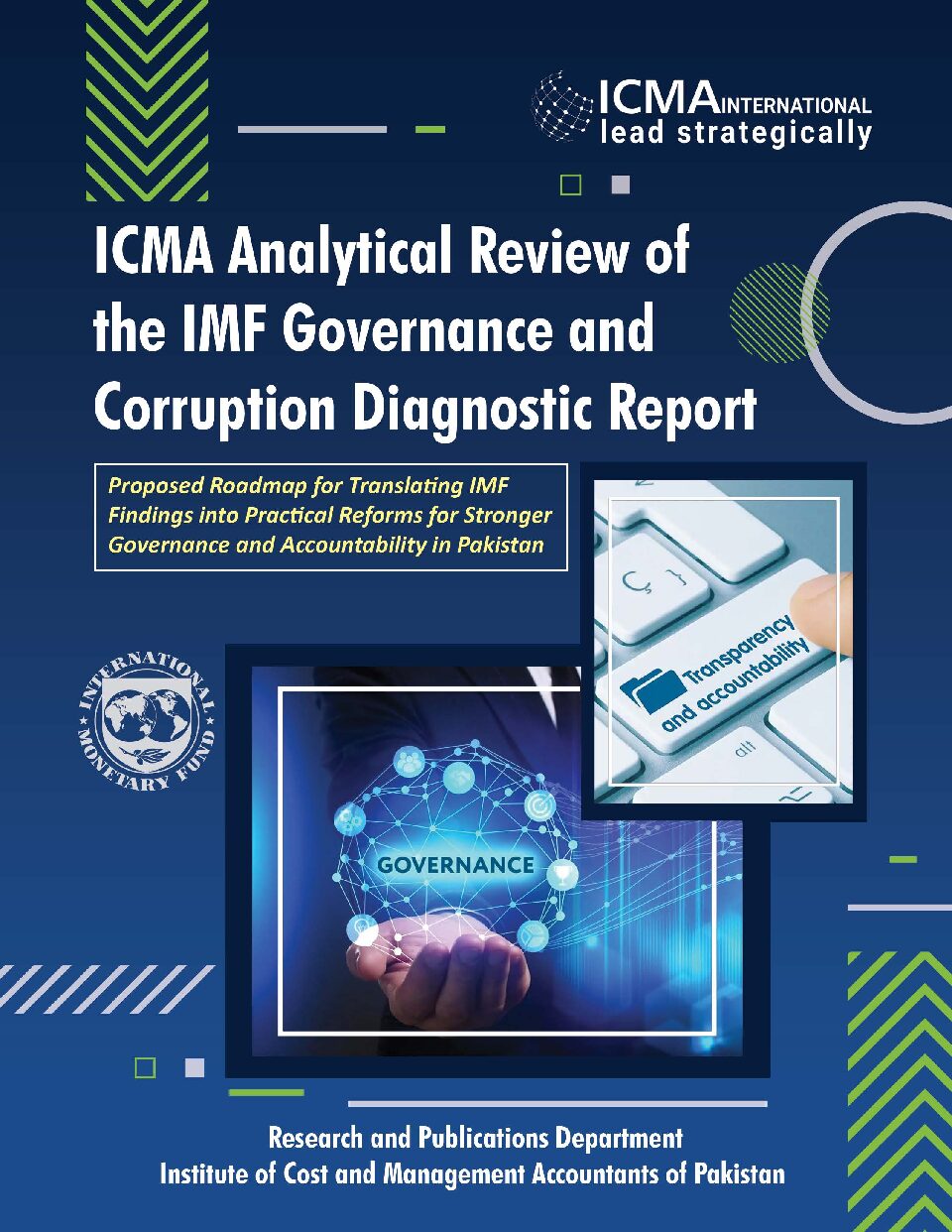
[Karachi – December 24, 2025]: Building directly upon the critical governance vulnerabilities identified by the International Monetary Fund (IMF) in its Technical Assistance Report on “Pakistan – Governance and Corruption Diagnostic Assessment (November 2025),” the Institute of Cost and Management Accountants (ICMA) today launched a definitive strategic roadmap to translate diagnostics into action. The report, developed by the ICMA Research and Publications Department, is titled “ICMA Analytical Review of the IMF Governance and Corruption Diagnostic Report” and provides the Government of Pakistan with a detailed, 32-pillar implementation framework designed to fortify institutions, reinforce public confidence, and unlock sustainable economic development. This blueprint systematically addresses the governance gaps that cost the economy billions annually and undermine citizens’ trust in public institutions.
This landmark review moves decisively from analysis to execution. It accepts the IMF’s findings on weaknesses in fiscal governance, revenue administration, judicial efficiency, and anti-corruption systems as the starting point. ICMA’s contribution is the meticulously researched “how”—a comprehensive set of professional, actionable recommendations that assign clear responsibility and phased timelines for reform.
In his message introducing the report, Mr. Muhammad Yasin, FCMA, Vice President ICMA and Chairman of the Research and Publications Committee, framed the document as a catalyst for collaborative national renewal. “The IMF has provided a clear diagnostic of systemic governance challenges. Our role, as a premier professional body, is to offer the prescription and the treatment plan,” he stated.
“This review contains a set of specific proposals across 32 priority areas. It is our professional duty and national contribution to provide this blueprint for building stronger, more transparent, and accountable institutions. We stand ready to support the government, the IMF, and all stakeholders in the vital work of implementation, leveraging the expertise of our members to drive meaningful and lasting reform.”
Crucially, the ICMA review transcends theoretical advice. It translates the IMF’s diagnostic into a Phased Implementation Matrix, assigning a set of specific actions to responsible agencies, including the Finance Division, FBR, and SECP, with clear short-, medium-, and long-term deadlines. This transforms high-level recommendations into an accountable, government-wide project plan, directly addressing the historic gap between reform pledges and on-the-ground execution.
The ICMA Operational Framework is structured around following five pillars to drive national renewal:
1) Fiscal Governance: Securing the Nation’s Finances
ICMA’s proposals target budget and revenue leaks that drain public resources. To address IMF concerns over opaque budgeting, the blueprint champions an independent Parliamentary Budget Office (PBO) for objective scrutiny and a Public Investment Monitoring Unit (PIMU) for real-time project oversight. It advocates a Revenue Intelligence Unit (RIU) within FBR for data-driven audits and a Tax Reform and Simplification Unit to rationalize complex laws. A dedicated SOE Performance and Oversight Unit is mandated to curb fiscal drains, while a consolidated Debt Management Office would bring transparency and discipline to national borrowing.
2) Rule of Law: Accelerating Justice
Responding to IMF findings on judicial backlog and weak contract enforcement, the plan addresses delayed justice that hinders business and citizen rights. It calls for specialized commercial benches, nationwide digital case management, and publication of court performance data. A central pillar is the strategic expansion of Alternative Dispute Resolution (ADR), empowering the International Mediation and Arbitration Centre (IMAC) to unclog courts. To instill integrity, a comprehensive national ethics framework with verified conflict-of-interest disclosures is outlined.
3) Anti-Corruption: Strengthening Accountability
The plan tackles the fragmented anti-corruption apparatus head-on. To counter fragmentation noted by the IMF, ICMA proposes a National Anti-Corruption Coordination Council (NACC) to unify NAB, FIA, and provincial agencies through shared intelligence. Enhanced whistleblower protections with secure channels are emphasized. The report calls for merit-based, transparent appointments for the heads of all key regulatory bodies (SECP, CCP, NAB) to ensure independence and effectiveness.
4) Digital & Regulatory Reform: Modernizing Governance
Looking ahead, the blueprint lays the foundation for a modern state. Aligning with global best practices, the vision includes full integration of NADRA’s digital identity across all government services. A National Business Registry would cut red tape, while the Competition Commission of Pakistan (CCP) would be equipped with a Digital Competition Framework. To bolster investor confidence, the Special Investment Facilitation Council (SIFC) is urged to adopt global standards by publishing detailed annual reports on facilitated investments.
5) Execution: Turning Plans into Results
Finally, recognizing that even the best plans fail without execution, the blueprint builds in mechanisms for delivery. It prescribes a national reform performance dashboard for real-time public tracking. A structured national stakeholder engagement framework and a robust public communication strategy are championed to build ownership, trust, and ensure reforms translate from paper to practice.
The “ICMA Analytical Review” is presented as a critical tool for Pakistan’s journey toward robust governance. It provides a credible, professional, and detailed plan to address the systemic challenges highlighted in the IMF program, offering a pathway to meet international obligations while fundamentally strengthening the nation’s institutional foundations for enduring prosperity. Implementing this roadmap is not merely a technical exercise; it is an investment in a future Pakistan defined by integrity, efficiency, and unlocked potential. ICMA reaffirms its commitment to supporting the Government of Pakistan and the IMF in the implementation of this blueprint to achieve meaningful and lasting national reforms.