

Exclusive By: Kanwal Abidi.
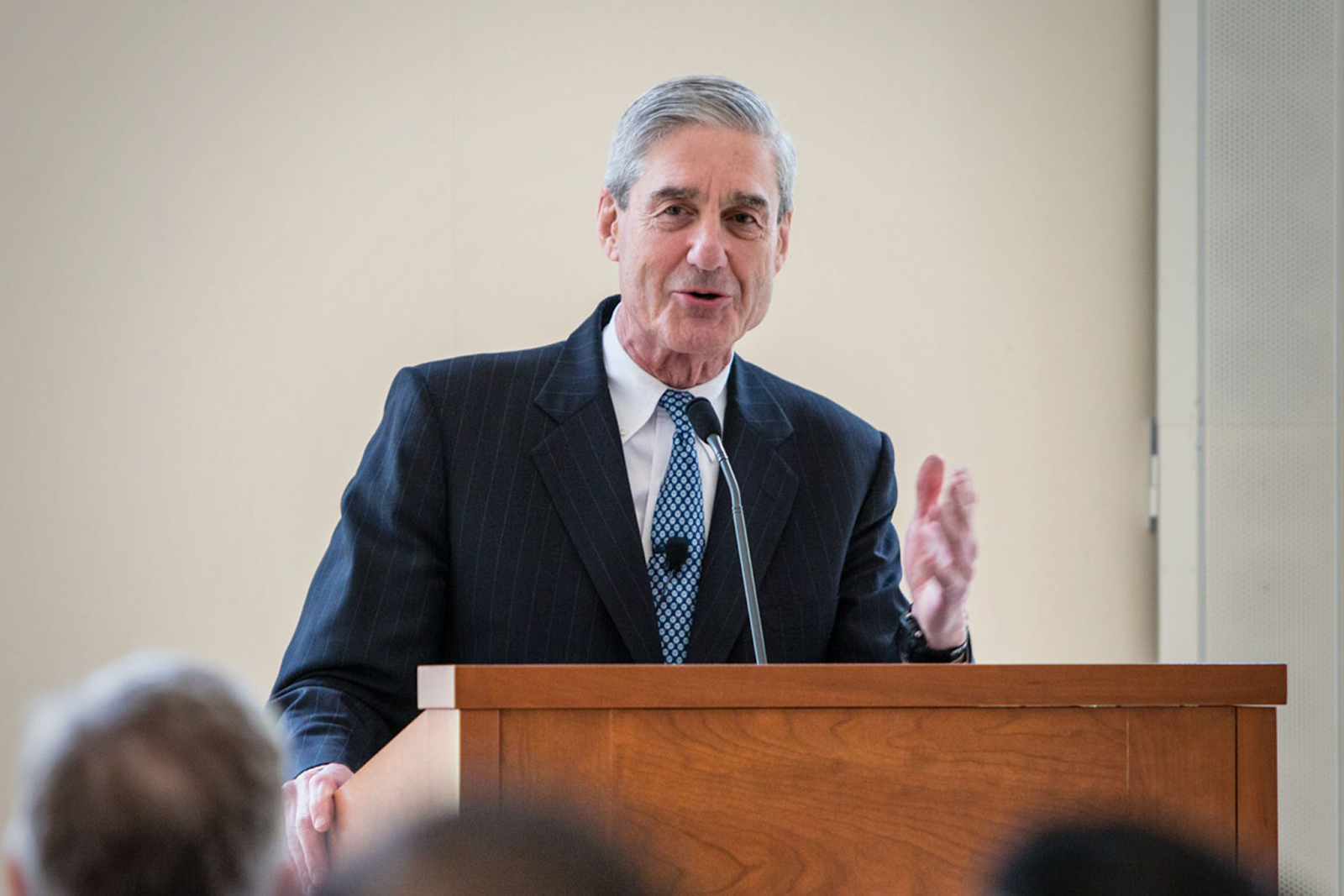
Washington D.C : Robert S. Mueller III, former FBI Director – appointed by Bush in 2001, few weeks before September 11 attacks, passed away at 81, in Charlottesville – Virginia.
Mueller’s family released a statement to the Associated Press on Saturday, “with deep sadness, we are sharing the news that Bob passed away on Friday night.” Further, his family has requested that “their privacy be respected."
Mueller has left an impressive heritage by being the second-longest serving FBI Director from 2001 to 2013, first on forefront was J.Edgar Hoover – stirred the nation’s top intelligence agency for 12 years, transforming it into a modern counter terrorism bureau, which addressed the growing domestic and homegrown terrorism challenge post 9/11 era.
As FBI Director he brought a new model of policing for the FBI, which was based on ‘preventive’ surveillance and national security powers, designed to confront an ascendant al- Qaida, interrupt plots and apprehend terrorists before they could act. In order to materialize it, the FBI shifted 2000 of the total 5000 agents at that time in the bureau’s criminal program to national security.
Mueller remained on the FBI job until 2013 – then during the Obama administration with an extraordinary vote of confidence, the Congress approved a two-year extension to remain on post as FBI Director. He was succeeded by James Comey. After his FBI’s tenure, he went into private practice for several years.
Later in his last days of career, Muller was asked by Deputy Attorney General Rod Rosenstein to return to public service as special counsel, in-charge of investigating ties between Russia and Trump 2016 presidential campaign. He was tasked to look into one of the most historic cases in American history. With his pragmatic and professional demeanour, Muller and his team spent nearly two years conducting the investigation. During this time, he made no public appearances and held no news conferences. He stood affirm, despite Trump and his supporters criticizing him so much, that Trump referred to it as “witch hunt.”
In the end, the 448-page “Mueller report” was thorough but ultimately inconclusive. It inferred that Russia interfered in the 2016 election in a “sweeping and systemic fashion”. However, it did not establish that members of the Trump campaign conspired or coordinated in these activities.
Mueller’s finding noted: “while this report did not conclude that the president committed a crime, it also does not exonerate him.”
The true stature of Mueller investigation into the 2016 election probe was enshrouded by polarization of politics. Democrats at large were frustrated that Muller was unable to deliver the outcome that they expected him to nail the Trump campaign 2016. And Republicans, at large, at one end witnessed the time of Mueller as a top security FBI cop, whereas on other end they saw Mueller’s investigation was referred to by Trump and his allies as a “hoax”.
On the forefront, the most notable service by Mueller was in the Vietnam War, where his military decorations and awards included the Bronze Star Medal with “V” device and “the Purple Heart.”
Robert Mueller was bestowed with the “Purple Heart” which is Badge of Military Merit, established by George Washington on 7th August 1782, who was Commander-in-Chief of the Continental Army.
Mueller, in his life, cited the combat death of his Princeton lacrosse teammate David Spencer Hackett in the Vietnam War as an influence on his decision to pursue military service. Of his classmate, Mueller said, “One of the reasons I went into the Marine Corps was because we lost a very good friend, a Marine in Vietnam, who was a year ahead of me at Princeton. There were a number of us we felt we should follow his example and at least go into the service. And it flows from there.”
Thus, in the summer of 1968, Mueller was deployed to South Vietnam, where he served as a rifle platoon leader with Second Platoon, H Company, 2nd Battalion, 4th Marines, 3rd Marine Division.
On 11th December 1968, Mueller in a military engagement in Operation Scotland II, he earned the Bronze Star with “V” device for combat valor after rescuing a wounded Marine under enemy fire during an ambush in which half of his platoon became casualties.
In April 1969, he was wounded in the thigh by enemy gunfire, recovered and returned to lead his platoon until June 1969. Mueller had initially considered a career in the Marine Corps, but later explained that he found non-combat life in the service unadventurous. After returning from South Vietnam, he was briefly stationed at Henderson Hall before leaving active duty service in August 1970 as a Captain.
Mueller in his life, reflected upon his service on one of the interviews: “I consider myself exceptionally lucky to have made it out of Vietnam. There were many who did not. And perhaps, because I did survive Vietnam, I have always felt compelled to contribute.”
Further, Muller received the 2016 Sylvanus Thayer Award for public service from the U.S. Military Academy. In June 2017, he received the Baker Award for intelligence and national security contributions from the nonprofit Intelligence and National Security Alliance.
One of Mueller’s former Marine classmates, who were stationed together in the Vietnam war wrote on his page “Man with a Gold Heart, who won a Purple Heart, will forever be cherished in our hearts!”