


By Dr. Gholam Mujtaba, MS, MD, Ed.D.
Washington, D.C. / Gulf Region — March 17, 2026
As the Middle East conflict intensifies, a dangerous parallel battle is unfolding—not only on the battlefield, but across media platforms. While Gulf and Arab states increasingly call upon the United States to cripple Iran’s military capabilities before any ceasefire, a misleading narrative is simultaneously being propagated: that this is a war against Muslims or a conflict of faith.
This assertion is not only inaccurate—it is strategically dangerous.
Not a War of Faith—A War of Strategic Security
Let it be stated with clarity and intellectual honesty:
This is not a war of Islam versus the West, nor a Sunni–Shia confrontation, nor a conflict between Muslim nations such as Afghanistan and Pakistan.
Rather, it is a geopolitical and security-driven conflict, rooted in:
• Military escalation
• Regional power competition
• Strategic deterrence failures
Even Iran has attempted to frame its actions as defensive rather than directed against neighboring Muslim states, emphasizing regional fraternity despite ongoing hostilities [5].
The Real Battlefield: Power, Not Religion
Historical and contemporary analysis confirms that regional rivalries—particularly between Iran and Gulf states—are primarily political and strategic, with sectarian elements often instrumentalized rather than foundational [8].
Today’s war reflects:
• Competition for regional dominance
• Control over energy corridors (Strait of Hormuz)
• Influence over proxy networks and security architecture
To reduce this complex reality into a “war of faith” is a gross oversimplification—and a deliberate distortion.
The Information War: Narratives and Their Handlers
A parallel “narrative war” is actively underway.
• Disinformation campaigns are shaping public perception and inflaming sentiment [3]
• Competing media narratives are attempting to draw regional actors into ideological camps [4]
These narratives serve strategic purposes:
• Mobilizing public emotion
• Justifying political positions
• Creating divisions within the Muslim world
The roots of such campaigns—and their handlers—are neither accidental nor obscure.
Ground Reality: Muslim States Themselves Are Divided
Contrary to the “Islam versus others” narrative:
• Gulf states have condemned Iranian strikes on their territory [6]
• Several Muslim-majority countries have called for de-escalation rather than religious mobilization [7]
• Iran’s own messaging distinguishes between U.S. targets and neighboring Muslim states [5]
There is no unified “Muslim bloc” in this war—only sovereign states pursuing national interests.
The Gulf Doctrine: Neutralize the Threat, Avoid Civilizational Conflict
While Gulf states demand decisive U.S. action to:
• Destroy Iran’s missile and drone capabilities
• Secure the Strait of Hormuz
• Contain IRGC influence
They are equally cautious about:
• Avoiding regional collapse
• Preventing sectarian escalation
• Ensuring the conflict does not evolve into a civilizational confrontation
Win the war militarily—but do not lose the peace ideologically.
The Greatest Risk: A Manufactured Clash of Civilizations
The most dangerous outcome of this conflict is not military escalation alone—it is the manufacturing of a “clash of civilizations” narrative.
Such a trajectory would:
• Polarize global Muslim populations
• Radicalize public opinion
• Expand the conflict into ideological confrontation
Scholarly work warns that misrepresentation of Islam in geopolitical conflicts can fuel long-term instability and division [9].
Strategic Conclusion: Reject the False Frame
The current war must be understood accurately.
It is:
• A conflict of power, security, and strategy
It is NOT:
• A war against Islam
• A war between Muslim nations
• A civilizational or religious confrontation
Final Strategic Warning
If mischaracterized as a war of faith, this conflict risks transforming into a global ideological confrontation far beyond the Middle East.
Avoiding that outcome is not merely desirable—it is imperative.
References
1 The Wall Street Journal, “Gulf States Urge U.S. to Cripple Iran Before Ceasefire,” March 2026.
2 Reuters, “Gulf States Press U.S. to Neutralize Iran as Hormuz Crisis Deepens,” March 16, 2026.
3 Al-Monitor / AFP, “Narrative War: Disinformation Surges in Middle East Conflict,” March 2026.
4 Arab News, “Competing Narratives and Information War in Gulf Conflict,” March 2026.
5 Al Jazeera, “Iran Sends Mixed Messages to Gulf Countries,” March 2026.
6 The Washington Post, “Gulf States Condemn Iranian Strikes,” March 2026.
7 The Guardian, “Global South Reactions to Iran War,” March 2026.
8 “Iran–Saudi Arabia Proxy Conflict,” geopolitical analysis, updated 2026.
9 Studies on media narratives and Islam in geopolitics, updated 2026.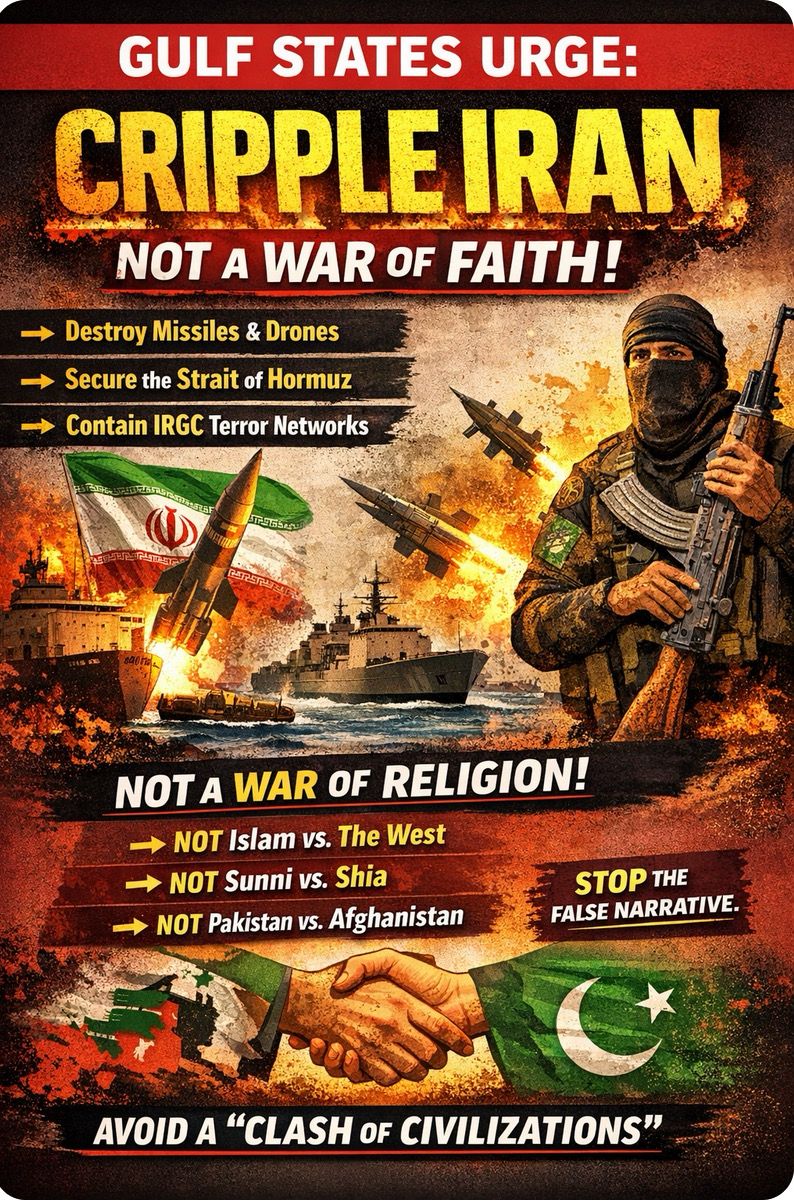
Author Introduction:
Dr. Gholam Mujtaba, MS, MD, Ed.D., is Chairman of the Pakistan Policy Institute USA (PPI-USA), a loyal Pakistani American, Republican leader, and a cabinet-level advisor to President Donald J. Trump. He writes on geopolitics, international security, and inter-parliamentary diplomacy.
https://medium.com/@greetmujtaba/gulf-strategic-pivot-arab-states-urge-decisive-u-s-e05ce5fd6879 (https://medium.com/@greetmujtaba/gulf-strategic-pivot-arab-states-urge-decisive-u-s-e05ce5fd6879)