

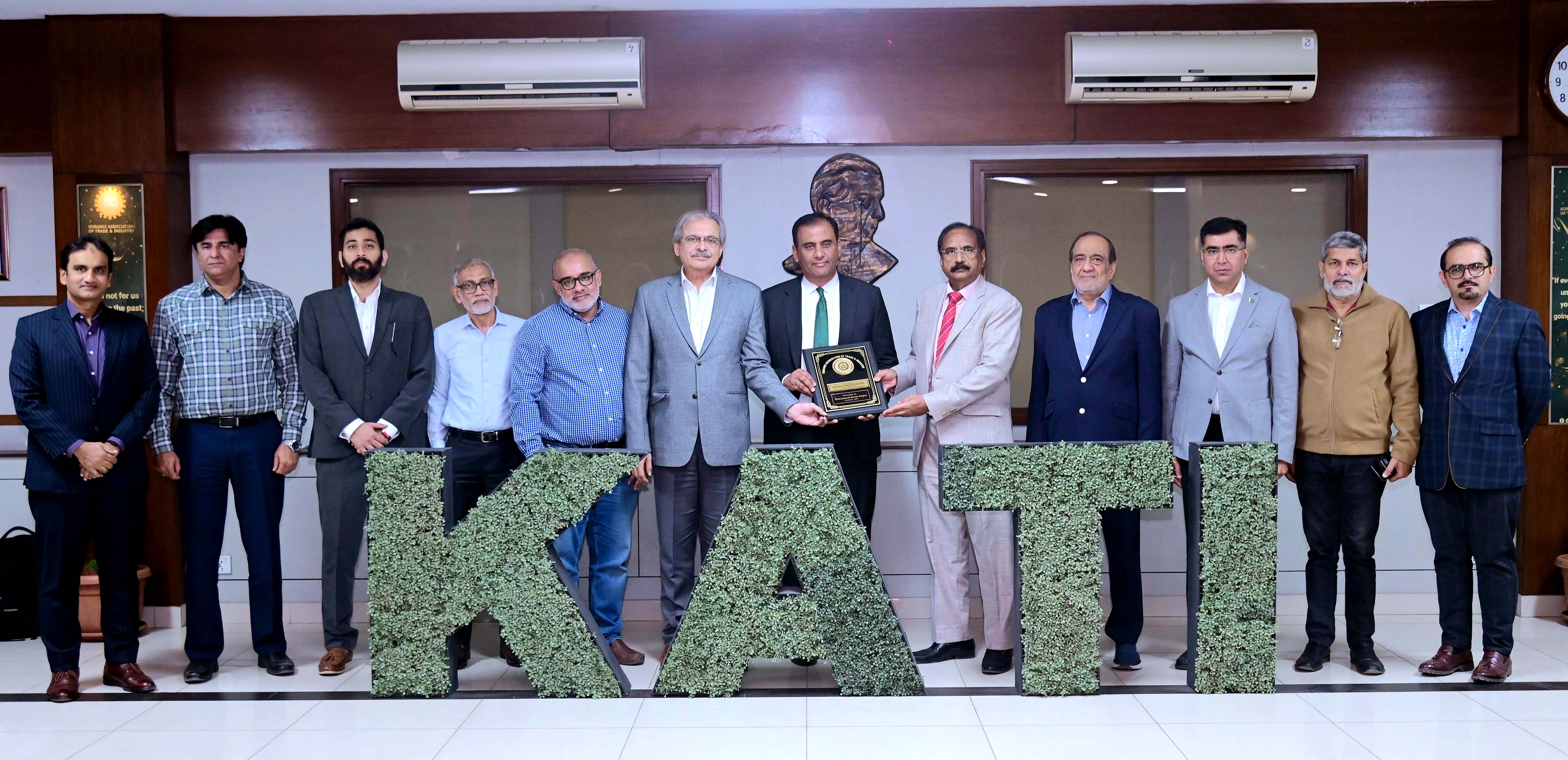
Karachi: Member Technical (Sindh) of the National Electric Power Regulatory Authority (NEPRA), Rafiq Ahmed Sheikh, has announced that a formal debate will be initiated on the issue of load factor following a proposal by the Korangi Association of Trade and Industry (KATI). He said efforts are under way to resolve power tariff issues and challenges being faced by the industrial sector.
He was addressing an interactive session during his visit to KATI, attended by industrialists in person and via Zoom. The meeting was chaired by KATI President Muhammad Ikram Rajput. Deputy Patron-in-Chief Zubair Chhaya, Senior Vice President Zahid Hameed, Chairman Standing Committee on NEPRA Rehan Javed, KITE CEO Saleem-uz-Zaman, Consultant Technical NEPRA Syed Safeer Hussain Shah, Director Ubedullah Memon, Assistant Director Asadullah Qureshi, along with representatives of trade bodies including the Pakistan Textile Export Association, All Pakistan Textile Mills Association, Karachi Chamber of Commerce and Industry also participated.
Rafiq Ahmed Sheikh said that a few years ago, it was noticed that industrial associations and stakeholders would be consulted in policy and decision-making for the power sector. In this regard, meetings were held with industrialists in Faisalabad, Sialkot, KATI and the Karachi Chamber, which proved highly beneficial in understanding industry issues more comprehensively. He stated that NEPRA’s core objective is to protect the interests of both consumers and the private
sector. He added that global best practices also support stakeholder representation in the consultative process to
ensure greater transparency.
He appreciated the patriotic spirit and commitment shown by industrialists during these engagements and said that while stakeholders are performing their duties with sincerity, certain systemic flaws continue to create challenges that need to be urgently addressed.
Earlier, KATI President Muhammad Ikram Rajput thanked Rafiq Ahmed Sheikh for his transparent and principled role throughout his Tenure as a NEPRA member. He stressed that incremental power packages should be designed strictly in line with industrial requirements. He said Karachi’s industry is already under immense pressure due to expensive electricity, high gas tariffs, fuel surcharges, repetitive taxes and unstable policies.
The KATI president termed the decision by NEPRA and the Power Division to recover Fuel Cost Adjustment (FCA) and Fuel Cost Component (FCC) from K-Electric consumers for FY 2023–24 as deeply alarming for industry. He said that despite the Multi-Year Tariff (MYT) being in place for K-Electric, past decisions were being altered and new financial burdens were being imposed, creating severe uncertainty in the business community.
Ikram Rajput further said it was an undeniable reality that Karachi’s industry was being used to subsidize loss-making power distribution companies in other parts of the country, which was completely unacceptable. He demanded the immediate withdrawal of the recent fuel surcharge recovery and urged the authorities to ensure the payment of the promised Rs. 33 billion incremental consumption package from the Covid period.
Deputy Patron-in-Chief Zubair Chhaya emphasized that NEPRA, as a regulator, plays a critical role at a time when
industrialization in Pakistan is declining due to some of the highest power tariffs in the region. He said industrialization is vital for job creation and economic stability, but this requires tariffs to be resolved in the right manner.
He pointed out that Pakistan’s total exports stand at around $32 billion, of which $17 billion comes from the textile sector alone. However, the textile industry has the potential to reach $25 billion in exports if competitive energy tariffs are ensured. He added that the economy is suffering due to the cycle of circular debt and incremental subsidies, and urged NEPRA to play its regulatory role to help break this cycle and enable national growth.
Chairman Standing Committee on NEPRA Rehan Javed said that although grid-related issues were largely resolved after K-Electric’s privatization, serious problems remain in the existing tariff structure. He observed that high electricity consumers were being penalized while low consumers were being subsidized under an unstable tariff regime.
He added that the biggest current issue is the tariff and that the application of load factor under the incremental
package remains unclear. He pointed out that industry is operating at a load factor of 16 to 30 percent, while Ministry are charging on the basis of a 60 percent load factor, which is inconsistent with ground realities. He demanded that the government fix the load factor at 40 percent.
Rehan Javed also expressed concern that despite higher tariffs and increased electricity consumption, capacity charges continue to rise. He stressed that the Ministry of Energy must revise the incremental package in line with actual industrial demand.
Senior representatives from Pakistan Textile Export Association, APTMA and the Karachi Chamber, includingPatron-in- Chief PTEA Khurram Mukhtar, Shahid Sattar from APTMA, Aamir Sheikh and Tanveer Bari from KCCI, also shared their proposals and concerns with NEPRA during the session.