


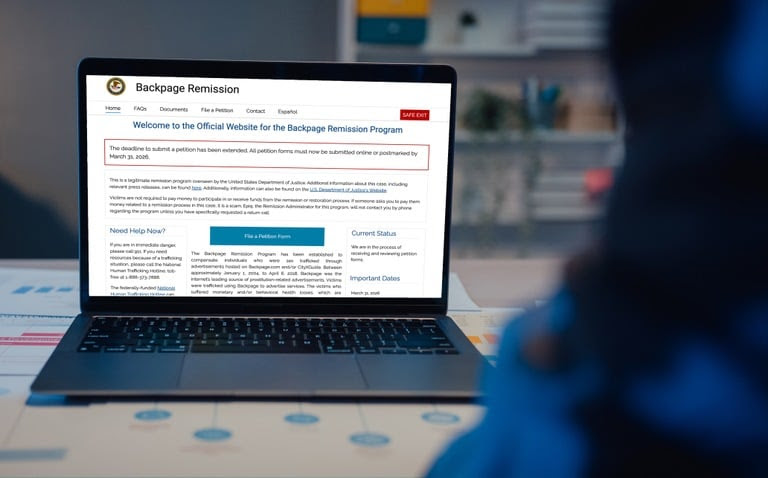
The FBI is urging people who were sex trafficked through classified ads on Backpage or CityXGuide—and suffered financial losses as a result—to apply for compensation through a special Department of Justice (DOJ) program before the March 31, 2026, deadline.
In July, Federal officials announced the launch of the Backpage Compensation Program to help trafficking victims recoup financial losses they encountered at the hands of Backpage and CityXGuide between 2004 and 2020. Last year, DOJ forfeited approximately $200 million in assets, which are available to compensate trafficking survivors for eligible financial losses, such as costs related to medical care, counseling, or lost income.
The FBI, DOJ, and partner agencies want to ensure all sex trafficking victims who suffered losses through the online platforms are aware of this opportunity for compensation.
“The goal is to return as much of the $200 million as possible to victims of trafficking,” said Desirae Tolhurst, the FBI Phoenix Field Office special agent who led the Backpage investigation. She said the most critical piece to providing financial relief is documentation—medical records, receipts, emails, and even records of their online advertisements.
Tolhurst, a white-collar crime investigator, said documentation can be difficult since aliases, prepaid mobile “burner” phones, and fake phone numbers are not uncommon in trafficking circles: “So, it’s not as straightforward as you might think.”
“The goal is to have as much of the $200 million as possible out to victims of trafficking on these sites.”
Desirae Tolhurst, special agent, FBI Phoenix
Partner agencies like the National Center for Missing & Exploited Children (NCMEC) are trying to make it easier for survivors to gather and provide necessary information. NCMEC is a non-profit organization whose mission is to reduce child sexual exploitation and prevent child victimization in partnership with law enforcement and the public through resources and reporting.
To that end, NCMEC created a Backpage Survivor Remission Network to connect eligible individuals with resources that can help them pursue compensation.
“We’ve been able to elevate our partnership with law firms, medical health clinicians, and so many others and bring them into the fold to support the larger good of this compensation process,” said Yiota Souras, chief legal officer for NCMEC. The organization launched its outreach effort on September 4 and by early December 2025 had placed more than 370 trafficking survivors with lawyers from about 35 national firms that are providing pro bono services.
“I certainly think it’s important to know that people can complete petitions on their own and submit them,” Souras said. “But I think it’s also important to know there are free resources available to help—a trusted partner to walk alongside survivors and help them through this.”
Backpage.com was once a major online marketplace for classified ads. From 2004 until 2018, criminals used the site to facilitate commercial sex and sex trafficking, including trafficking of minors. The federal government seized Backpage.com in April 2018 and later brought criminal charges and filed civil forfeiture complaints.
The site’s owners and administrators have since been found guilty of multiple offenses, including conspiring to facilitate unlawful commercial sex and money laundering. Several were sentenced to federal prison.
“It’s also important to know there are free resources available to help—a trusted partner to walk alongside survivors and help them through this.”
Yiota Souras, chief legal officer, National Center for Missing & Exploited Children

Federal authorities shut down and seized Backpage.com in 2018.
The data gleaned from Backpage’s seized databases dates back to 2004 and is only as reliable as the information that was included: alias names, obscured faces, and old phone numbers. That is why DOJ has run digital media campaigns on multiple social media platforms and reached out to over a hundred non-governmental organizations and service providers to reach trafficked victims wherever they are.
Individuals may qualify for compensation if their trafficking was facilitated through ads posted on Backpage.com between January 1, 2004, and April 6, 2018, and on its successor site, CityXGuide, between April 8, 2018, to June 19, 2020. Victims can file petitions themselves, or petitions may be filed by representatives or by the estates of victims who have died.
To learn more or submit a petition, visit BackpageRemission.com.
Backpage case at a glance
What was Backpage?
A major online classifieds site operating from 2004 to 2018, best known for its “adult services” section.
Allegations
Federal prosecutors said Backpage knowingly allowed ads that promoted commercial sex and sex trafficking, including trafficking of minors, while claiming it was a neutral platform.
Investigation and shutdown
After years of state and federal investigations, the FBI seized Backpage on April 6, 2018. The site’s founders and executives faced federal charges related to facilitating prostitution and money laundering.
Evidence cited
Investigators pointed to internal emails, ad editing practices, and revenue from adult ads as proof the company profited from illegal activity tied to trafficking. Details
Victim relief
A federal compensation program now allows eligible trafficking victims linked to Backpage to apply for compensation for financial losses tied to their exploitation.
About the remissions program
The?Backpage Remission Program?is a United States Department of Justice (DOJ) initiative to compensate victims of sex trafficking whose abuse was facilitated through advertisements on Backpage.com and/or CityXGuide.com. The program will use over?$200 million in forfeited assets?seized from the websites during criminal investigations.
Purpose: To provide financial relief to trafficking survivors for documented monetary losses, such as medical expenses, behavioral health costs, and lost wages.
Eligibility window: Victims trafficked via Backpage.com (January 1, 2004, to April 6, 2018) or CityXGuide.com (April 8, 2018, to June 19, 2020).
Application deadline: March 31, 2026.
Cost: The application process is free; survivors are not required to pay any money to participate.