

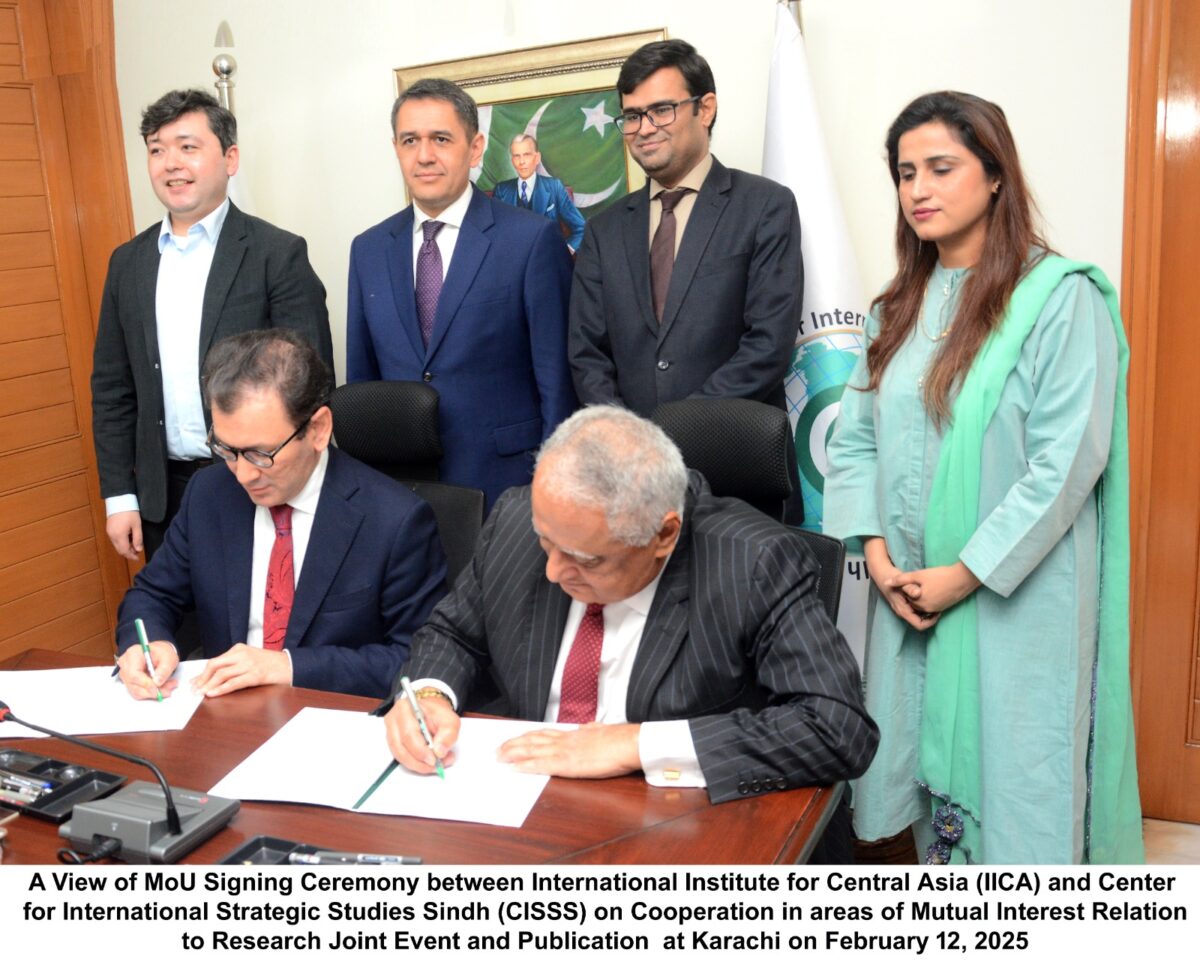
Karachi: The Center for International Strategic Studies Sindh (CISSS) has formalized an institutional collaboration with the Tashkent-based International Institute for Central Asia (IICA) through the signing of a Memorandum of Understanding (MoU). This MoU aims to foster research and dialogue on a wide range of strategic, economic, and geopolitical issues of mutual interest.
The MoU was signed by Ambassador (R) Qazi M. Khalilullah, Executive Director of CISSS, and Ambassador (R) Javlon Vakhabov, Managing Director of IICA, representing their respective institutions.
Speaking at the signing ceremony, Ambassador Qazi M. Khalilullah underscored Pakistan’s commitment to strengthening engagement with Central Asian Republics (CARs) and prioritized five key areas: political and diplomatic cooperation, trade and investment, energy and connectivity, security and defense, and people-to-people exchanges.
He further commended the steady progress in Pakistan-Central Asia relations, as evidenced by the establishment of a strategic partnership and the signing of landmark transit trade and preferential trade agreements.
Highlighting Pakistan’s strategic geographical advantage, Ambassador Khalilullah emphasized that the country provides the shortest land route for Central Asian states to access global markets through the ports of Pakistan.
He also referenced major regional connectivity projects, particularly the Trans-Afghan Railway Project, and stressed the need to integrate the China-Pakistan Economic Corridor (CPEC) with other regional initiatives to enhance economic interconnectivity.
Mr. Javlon Vakhabov, in his remarks, expressed confidence in the collaboration between CISSS and IICA, emphasizing the importance of expert consultations on regional connectivity.
He highlighted the mutual benefits of enhancing the Uzbekistan-Afghanistan-
The partnership between CISSS and IICA is expected to contribute significantly to regional discourse, policy research, and strategic dialogue, fostering a deeper understanding of shared challenges and opportunities in an evolving geopolitical landscape.
Advertisements