

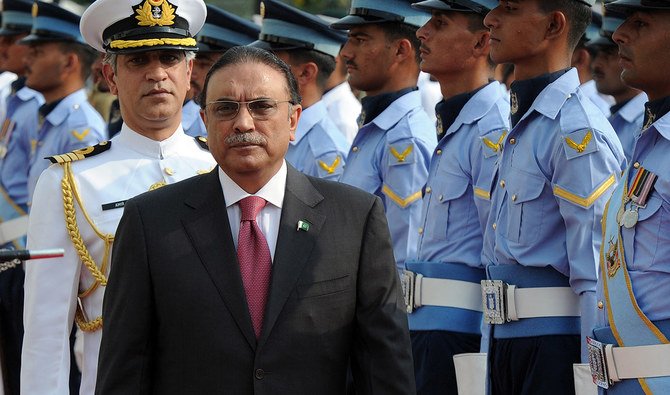
In Islamabad, legislators in Pakistan’s national and provincial assemblies, as well as the Senate, cast their votes on Saturday to elect the country’s 14th president. Former president Asif Ali Zardari seems likely to return to the presidency in Islamabad for a second term.
Zardari was proposed for the position by the ruling coalition led by Prime Minister Shehbaz Sharif. He is competing against Mahmood Khan Achakzai, supported by the incarcerated former prime minister Imran Khan-led opposition.
In Pakistan, the president is chosen by members of an electoral college, which includes both the upper and lower houses of parliament, as well as all four provincial assemblies. Voting for the election commenced at 10 am and will continue until 4 pm without interruption.
Accompanied by members of his Pakistan Peoples Party (PPP), the former president arrived at the Parliament House in Islamabad to cast his vote in Saturday’s election. When asked by a reporter if he would be working towards further constitutional reforms, Zardari stated that he only provided advice and that the legislation, including the 18th amendment, was carried out by parliament.
“That was all accomplished by parliament,” the presidential candidate stated in televised remarks. “We provided advice and parliament did it with a two-thirds majority. God willing, this time as well, parliament will do it.”
During his previous term as president, Zardari introduced constitutional reforms, such as the 18th amendment to the constitution, which granted greater autonomy to provinces and curtailed presidential powers.
Nonetheless, it is expected that the 68-year-old’s second term will see him preside over a mostly ceremonial office.
Legislators exercised their voting rights during a joint session of parliament, consisting of the National Assembly and the Senate, in Islamabad on Saturday afternoon. The presidential election voting was conducted by secret ballot.
Likewise, provincial assemblies also convened on Saturday for the presidential election.
On Friday, Pakistan’s outgoing President Arif Alvi received a farewell guard of honor. Alvi’s five-year term concluded in September of last year, but in Pakistan, a president can constitutionally remain in office until his successor is elected.
Alvi, who took office on September 9, 2018, after Khan’s Pakistan Tehreek-e-Insaf (PTI) party came to power in the same year’s election, presided over a period marked by political instability and civil-military tensions. His tenure also witnessed Khan’s ouster in a parliamentary no-confidence vote in April 2022.
In addition to political turmoil, Pakistan faced an economic crisis during this period, narrowly avoiding default in June last year by securing a $3 billion bailout from the International Monetary Fund (IMF).