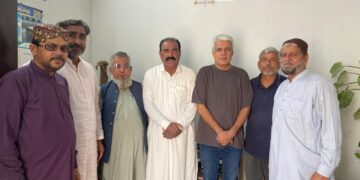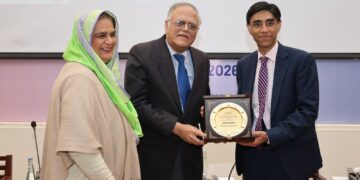


Karachi : Arts Council of Pakistan Karachi organized a session titled “Manto aur Aaj ki Dunya” on the death anniversary of the renowned Writer Saadat Hasan Manto at Haseena Moin Hall. The session featured an in-depth talk by human rights activist and poet of Urdu, Punjabi, and English Harris Khalique, while the Session were moderated by well-known anchor and journalist Absa Komal. President Arts Council Muhammad Ahmed Shah, senior journalist Ghazi Salahuddin, Noor-ul-Huda Shah, Ayub Sheikh, Dr. Qaiser Sajjad, Sadiqa Salahuddin, along with a large number of literary and social figures, attended the session. On behalf of Arts Council of Pakistan Karachi, President Muhammad Ahmed Shah presented bouquets to Harris Khalique and Absa Komal. The discussion began with references to Manto’s letters written between 1951 and 1954.On the occasion, Harris Khalique said that there was no fixed or final continuity in Manto’s work, which distinguished him from other prominent writers. During Manto’s time, there was a clear division between right-wing and left-wing writers. Those who were considered progressive writers often criticized Manto. He said that Manto viewed Pakistan and India equally and wrote in the language of a marginalized nation. The global trends of the 1950s and 1960s still exist today in different forms. Although technology has changed, basic interests remain the same. Smiles and weaknesses are human traits, and the burden of false sanctity should not be imposed. Harris Khalique stated that Manto understood that the process of Partition did not end in 1947 but actually began then. Some people believe they alone authored the narrative of Partition, whereas the region had figures like Sardar Patel and Manto alike. He emphasized that it is incorrect to view the entire West as a single monologue or uniform ideology. Alongside unity, dissenting voices have always existed in the West. Similarly, many important personalities have emerged in the neighboring country. In Lahore and across the region, several individuals challenge the dominant narrative. A large number of writers and artists continue to present alternative perspectives. The art community should not be confined to a single ideology. He further explained that when we refer to the “West,” it does not mean ordinary people, but rather the powerful class that controls dominance, authority, and the market economy. The real discussion revolves around those forces that control global markets. The relationship between the working class, writers, and journalists has weakened, and there is a strong need to reconnect them at a global level. Harris Khalique noted that great writers emerge in every era, though the language changes. People are still writing across the world, yet writers continue to face restrictions. While the state performs its role, society often moves two steps ahead. Patriotism means different things to different individuals. He quoted Manto as saying: “Neither am I the country, nor the government, nor the treasury; I am only one who speaks the truth.”He added that people remain unaware of many realities. In today’s time, there is no writer who documents his era the way Manto did. Manto did not see people as Hindu or Muslim, but as human beings. Absa Komal said that Manto’s famous line, “I am poor because my country is poor,” still holds true today. No matter how many cars we buy or housing societies we build, increasing population and limited employment opportunities continue to reflect this reality. She emphasized that to portray today’s narrow-minded society, a writer like Manto is still needed.


ADVERTISEMENT