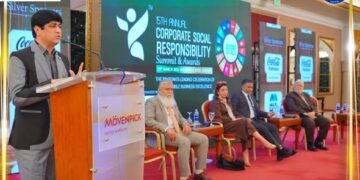


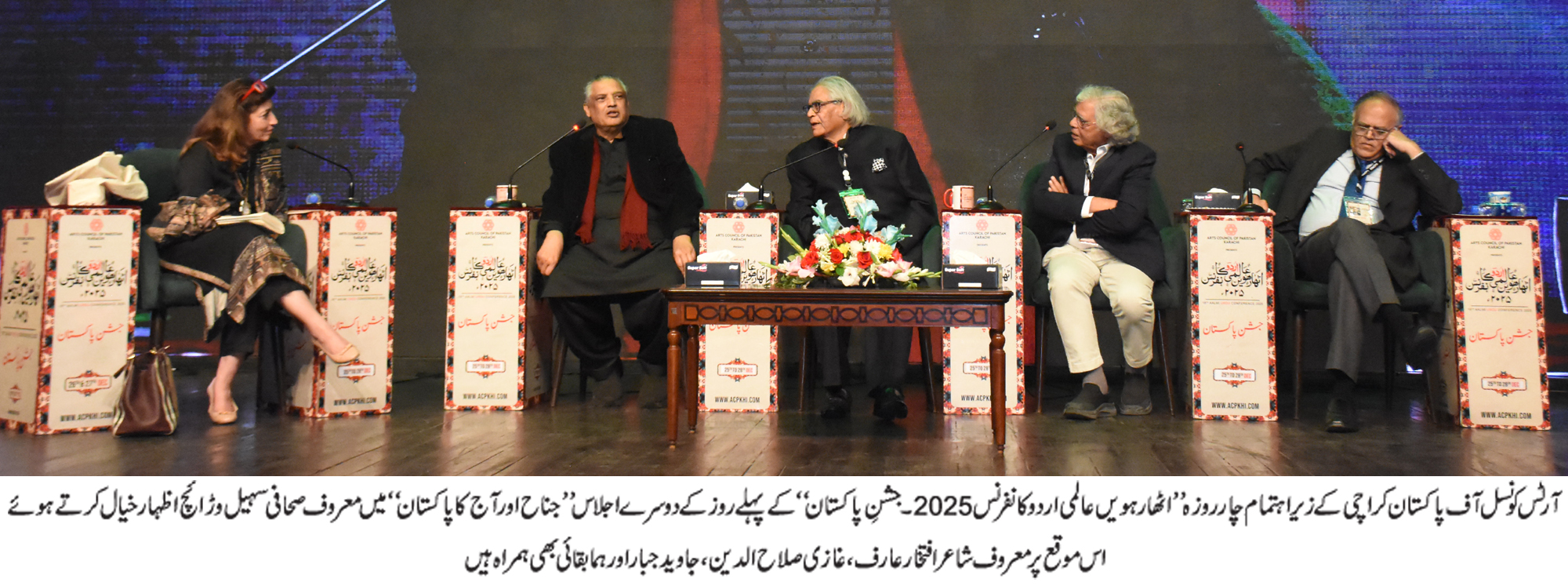
Karachi: Arts Council of Pakistan Karachi Organized the second session on the first day of the four-day “18th Aalmi Urdu Conference 2025 – Jashan-e-Pakistan” was held under the title “Jinnah aur Aaj ka Pakistan ” at Auditorium I. Renowned poet Iftikhar Arif, Javed Jabbar, Ghazi Salahuddin, and Suhail Warraich spoke on the topic, while Huma Baqai performed the duties of moderator. Renowned poet Iftikhar Arif said that, along with Quaid-e-Azam Muhammad Ali Jinnah, many other personalities played an important role in the creation of Pakistan, but they are mentioned very little. He said that we suffered severe damage due to the Pakistan Studies curriculum, because many questions are arising today since facts were neither written nor conveyed properly in the past. Quaid-e-Azam had a clear stance regarding language, but unfortunately, hatred was instilled in our society. Every country requires a link language, and in Pakistan, this role is played by Urdu. Ghazi Salahuddin said that Jinnah’s Pakistan and today’s Pakistan are not the same but are two different realities. Quaid-e-Azam gave the message of unity, faith, and discipline. In the speech of August 11, 1947, it was clearly declared that all citizens are free. He questioned whether we truly are the Pakistan envisioned by Quaid-e-Azam. He said that Quaid-e-Azam’s concept of Pakistan was altered over time due to political interests. Unfortunately, we neither want to read history, nor listen to it, nor learn lessons from it. Journalist Suhail Warraich said that among the Muslims of the Subcontinent, Sir Syed Ahmad Khan placed the greatest emphasis on education, but due to the
conditions of that era, he could not openly speak about women’s education. In contrast, Quaid-e-Azam Muhammad Ali Jinnah was a supporter of Muslim women’s education and rights from the very beginning. Fatima Jinnah was the first Muslim woman of the Subcontinent for whom Quaid-e-Azam personally established a private dental clinic. Quaid-e-Azam always spoke for women’s freedom and equality. Today, Quaid-e-Azam’s birth anniversary and Christmas are being observed together. One hundred and eighteen years ago, the British government made promises of self-governance and democracy in the Subcontinent. There was also a time when strict restrictions were imposed on the media.
He said that the wheel of history should move forward, not backwards. Javed Jabbar said that Muslim nationhood did not end in 1971 but is still alive today. He said that Pakistan is currently facing severe challenges and that our electoral system has become extremely weak. Today’s world and today’s Pakistan are standing in completely different circumstances. To end the existing contradictions with our neighbouring country, we will have to engage in serious, strong, and responsible dialogue. He said that every citizen has the right to criticism, but baseless criticism of state institutions and the armed forces of Pakistan is unacceptable under any circumstances.


ADVERTISEMENT