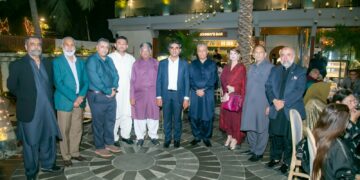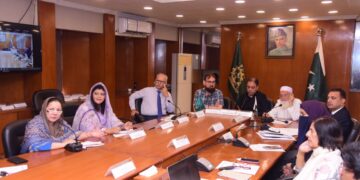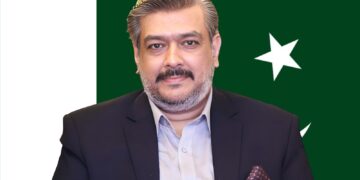


Karachi : The Arts Council of Pakistan Karachi, in collaboration with the All Parties Hurriyat Conference (Jammu and Kashmir), hosted a seminar commemorating 9th martyrdom anniversary of Burhan Muzaffar Wani. Themed “The Martyr’s Death is the Life of the Nation,” the event took place at Haseena Moin Hall and featured Sindh’s Minister for Local Government, Saeed Ghani, as the chief guest.
The seminar brought together prominent voices from across political and civil society circles. Key participants included Ghulam Muhammad Safi (Convener, Hurriyat Conference), Advocate Syed Parvez Shah, Syed Yousuf Naseem, Kashmiri leader Sardar Umm-e-Kulsoom, MPA Talha Ahmed Khan, Nadeem Awan, PPP leader Iqbal Kashmiri, Sardar Nazakat, PML-N’s Sardar Sagheer, and Muhammad Arshad Sher Baloch, Convener of PML-F’s Karachi Division. The event was moderated by Bashir Sadozai.
In his keynote address, Minister Saeed Ghani described Burhan Wani as “a symbol of valour” and urged the youth of Pakistan to learn about his life and legacy. “This is not just a struggle of years. It spans nearly eight decades,” he remarked. “Mistakes are human, but not when it comes to Kashmir.” He lauded the late Shaheed Benazir Bhutto for her efforts in internationalizing the Kashmir issue and criticized India’s attempts to blame Pakistan for the recent Pahalgam attack, declaring, “India’s diplomatic facade collapsed within seconds.” Ghani also praised Pakistan’s armed forces for their steadfast support of the Kashmiri people.
Hurriyat Convener Ghulam Muhammad Safi emphasized the enduring impact of Wani’s sacrifice, stating, “His martyrdom is a beacon for our direction.” He also condemned India’s military interventions beyond Kashmir, notably in Palestine and Gaza, and urged unity, strategic awareness, and faith.
Senior Hurriyat leader Syed Yousuf Naseem highlighted that Wani, a student, inspired an entire generation of Kashmiri youth. “Every child in Kashmir is now part of the freedom movement,” he said, reaffirming that the struggle for liberation will continue until the region is free from Indian occupation.
Advocate Syed Parvez Shah recalled how Wani used a mobile phone to launch a digital revolution. “His videos shook India,” he noted. “Today, young Kashmiris aspire to follow in his footsteps.” He stressed that though they lack military might, the spirit of resistance among a few devoted fighters has inspired the world.
Kashmiri leader Sardar Umm-e-Kulsoom voiced hope that the sacrifices made would soon yield results. She criticized the global reduction of the Kashmir and Palestine issues to “mere conferences,” and highlighted that the UN recognizes the right of Kashmiris to self-determination.
PPP’s Sardar Nazakat paid tribute to the countless young martyrs of Kashmir, asserting that the people’s resilience would soon bring victory. Similarly, Iqbal Kashmiri praised Wani’s legacy for instilling renewed determination among Kashmiri youth.
Sardar Sagheer voiced concern that the Kashmir issue was fading from public consciousness. “Today we honour a hero who gave his life for his homeland,” he said, calling it an unresolved global dispute.
Nadeem Awan spotlighted Wani’s adept use of social media in the freedom struggle and commended the unwavering commitment of the Kashmiri people, often surpassing that of many Pakistanis
MPA Talha Ahmed Khan quoted Wani’s powerful words: “You may tire of killing us, but we will never tire of dying.” He urged for concrete action beyond symbolic gestures, warning that Indian Prime Minister Modi poses a threat not just to Pakistan, Kashmir, and Palestine, but to India itself.
Muhammad Arshad Sher Baloch concluded the session with a call for unity and reflection on Wani’s martyrdom. “The blood of this 26-year-old reminds us of our enduring connection to Kashmir,” he stated.