Shenzhen Summit Trump’s Personal Diplomacy Faces Test After Meeting Xi and Putin
The three leaders issue a symbolic nuclear peace declaration but make no major breakthroughs on Iran, Ukraine, Taiwan, trade or arms control.
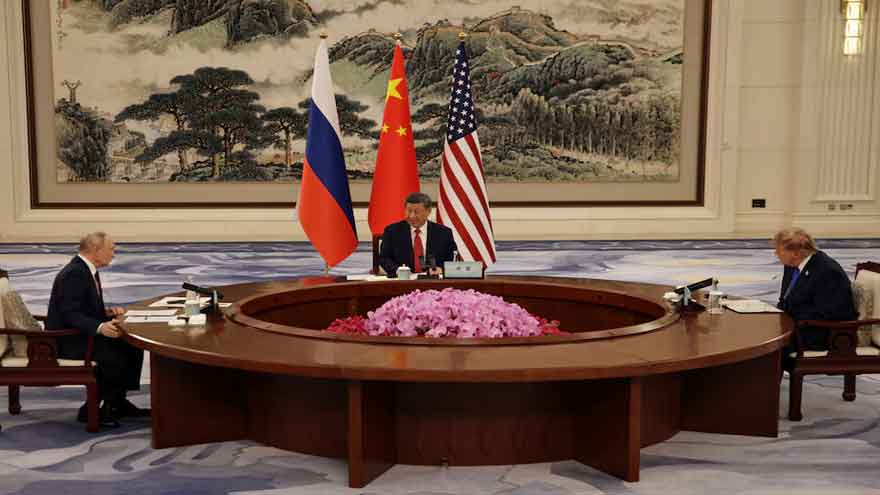
Shenzhen Summit Donald Trump, Xi Jinping and Vladimir Putin meet in China.
US President Donald Trump’s personal approach to international diplomacy has faced fresh questions after his meeting with Chinese President Xi Jinping and Russian President Vladimir Putin in Shenzhen, China.
The unprecedented three-way summit produced a symbolic declaration on nuclear peace. However, it failed to deliver major agreements on arms control, regional conflicts or economic disputes, according to analysts.
Trump entered the meeting seeking to strengthen his international standing. His political position at home had weakened following his Republican Party’s loss of control of Congress in the midterm elections. Meanwhile, the ongoing conflict with Iran had also affected his approval ratings.
The three leaders reaffirmed that nuclear war must never be fought. They also agreed to hold a dialogue on reducing nuclear risks. However, they announced no timetable for discussions and made no significant progress towards the arms control agreement Trump has sought.
The summit also produced no apparent breakthrough on Iran, Ukraine or Taiwan. Differences over trade and artificial intelligence remained unresolved.
Instead, analysts said the meeting allowed all three leaders to project diplomatic influence without making major concessions. Xi strengthened China’s image as a host of high-level international diplomacy. Putin, meanwhile, gained an opportunity to appear alongside the leaders of the world’s two most powerful countries.
Some analysts warned that the outcome could weaken Trump’s international standing while benefiting Washington’s strategic rivals.
Christopher Preble, a senior fellow at the Stimson Center in Washington, said Trump had secured the high-profile encounter he wanted. However, he questioned whether the meeting delivered meaningful results on major international issues.
Asim Munir Security Forces Vow to Eliminate Terrorism During North Waziristan Visit
The summit followed a pattern of Trump’s earlier meetings with Xi and Putin, which also failed to produce major breakthroughs. His first-term meetings with North Korean leader Kim Jong Un similarly generated international attention but limited concrete progress.
The White House defended Trump’s approach. Spokeswoman Anna Kelly told Reuters that the president had restored American strength after what she described as four years of weakness under former president Joe Biden. She said his Asian engagements demonstrated the respect other world leaders showed the United States.
Trump has repeatedly defended direct engagement with leaders such as Xi, Putin and Kim Jong Un. He argues that personal diplomacy can achieve results that traditional diplomatic channels may not deliver.
However, critics say such meetings require clear objectives and careful preparation. They have also accused Trump of placing too much emphasis on personal relationships with authoritarian leaders while putting pressure on traditional US allies.
Trump gave the Shenzhen meeting a positive assessment. Speaking to NBC News, he rated it 12 out of 10. He has also suggested that the elaborate military welcome Xi arranged at the airport was itself a diplomatic achievement.
The meeting drew comparisons with the 1945 Yalta Conference, where the United States, Britain and the Soviet Union discussed the post-Second World War order. However, the Shenzhen gathering lasted less than 90 minutes and produced no comparable agreements.
The comparison raised concerns in Ukraine, which continues to face Russia’s invasion. European leaders also expressed unease over their absence from the discussions.
European leaders met in Berlin on the same day to demonstrate support for Ukraine. German Chancellor Friedrich Merz described the Shenzhen meeting as apparently little more than a photo opportunity. He also criticised Trump’s warm public remarks about Putin.
The summit has raised further questions about Trump’s diplomatic priorities ahead of the Group of 20 meeting scheduled for mid-December at his golf resort in Florida. Xi is expected to attend, while analysts have also discussed the possibility of Putin joining the gathering. However, the Russian president has not received a formal invitation.
US Senate Democratic leader Chuck Schumer criticised Trump’s meeting with Xi and Putin. He described it as a historic embarrassment and said the president had secured no lasting commitments from either country.
Despite the limited outcomes, some arms control experts viewed the nuclear declaration as a positive development.
Daryl Kimball, executive director of the Arms Control Association, welcomed the leaders’ reaffirmation that nuclear war cannot be won and must never be fought. However, he stressed that words alone were insufficient and called for concrete action.
Trump also acknowledged the difficulty of securing a three-way nuclear arms agreement. Speaking to Reuters during his return flight to Washington, he described such a deal as extremely difficult to achieve. China has resisted joining existing arms control arrangements because its nuclear arsenal remains smaller than those of the United States and Russia.
Analysts say Trump may continue relying on direct leader-to-leader diplomacy during the remaining years of his presidency. However, they argue that the lasting impact of the Shenzhen summit will depend on whether it produces tangible results.
Josh Lipsky, vice-president of international economics at the Atlantic Council, said the eventual outcomes in Iran and Ukraine would help determine how history judges the meeting.