Trump Escalates Trade War With Canada as Tariffs and Import Bans Expand
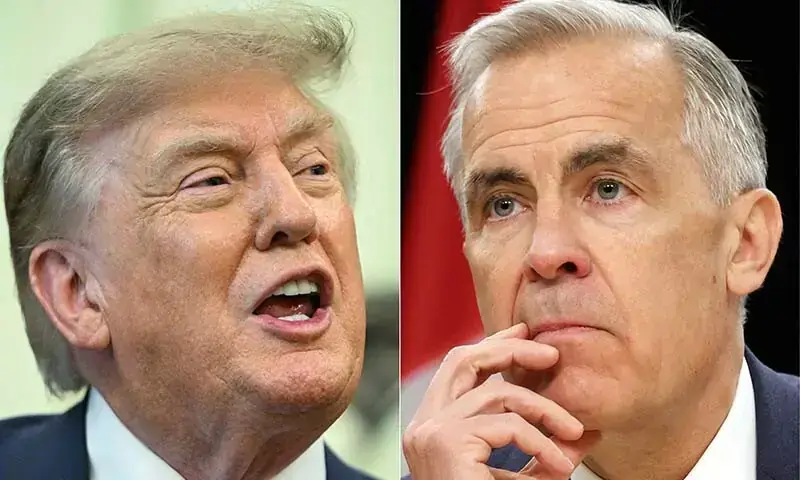
US President Donald Trump and Canadian Prime Minister Mark Carney face rising tensions over trade and tariffs.
US President Donald Trump escalated his Canada trade war on Tuesday by imposing new tariffs and import restrictions on Canadian products.
The latest measures target alcohol, dairy products, mattresses, motorboats and golf carts. They add further pressure to already strained economic ties between the two countries.
A 50 per cent surcharge on a range of Canadian products will take effect on September 15, according to Trump’s executive order.
Meanwhile, another order will ban imports of certain alcoholic beverages and dairy products, including whey. That measure is scheduled to begin on September 29.
Canada Hits Back With Tariffs
Canada also introduced retaliatory tariffs on Tuesday.
The measures cover about $20 billion worth of US imports. They include steel, aluminium and dairy products such as cheese.
Ottawa introduced the tariffs in response to duties announced by Washington on August 22.
Canadian Prime Minister Mark Carney said the country had the resources to reduce its economic dependence on the United States.
Majmua The Art Gallery Showcases 16 Emerging Artists in Karachi
“Canada has everything we need to pivot and prosper,” Carney said in a video address.
He acknowledged that changing trade patterns would carry economic costs. However, he argued that those costs would be lower than remaining dependent on the US market.
Trump Targets Canadian Companies
Trump also threatened to restrict Canadian companies from receiving US government contracts.
He said officials would remove Canadian-origin products from the General Services Administration’s Multiple Award Schedules.
The programme accounts for more than $50 billion in government contracts each year, according to Trump.
The president has also targeted Bombardier Aviation. On Monday, he threatened to restrict sales of the Canadian aircraft maker unless it moves more manufacturing to the United States.
Bombardier defended its US operations. The company said it supports tens of thousands of jobs across the country.
The company has direct employees in more than 20 US states. These include Kansas, Texas, Arizona and California.
Bombardier Pressure Draws US Senate Response
The latest threat has also raised concerns among US lawmakers.
Kansas senators Roger Marshall and Jerry Moran said they were working to protect Bombardier’s jobs in the state.
Marshall said he had already raised the issue with the White House. Bombardier employs more than 1,200 people in Kansas.
Economists say the tariffs pose a modest negative risk to Canada’s overall economy. However, the impact could be greater on manufacturing centres in central Canada.
Carney Rejects Further Escalation
Carney said Ottawa did not want to prolong the dispute.
“I don’t believe in escalating the conflict,” he said. “That’s not constructive.”
However, he defended Canada’s retaliatory measures.
Carney said the tariffs were needed to protect Canadian workers, companies and communities.
Trade Minister Dominic LeBlanc said Ottawa was reviewing the latest US measures.
Trade Talks Remain Frozen
Relations between Washington and Ottawa have deteriorated sharply in recent weeks.
Negotiations broke down on August 21 after several days of talks in Washington.
Carney later said US negotiators had introduced new restrictions at the final stage of discussions. He also criticised what he described as threats involving the French language and Quebec culture.
The two governments have not resumed formal negotiations since then.
Trump has also repeatedly used provocative rhetoric over Canada.
On Sunday, he shared an illustration showing himself towering over Carney during an ice hockey game. The post reflected his long-running suggestion that Canada should become part of the United States.
Canada Seeks to Reduce US Dependence
The dispute comes as Canada faces a difficult economic challenge.
Nearly 60 per cent of Canada’s imports come from the United States. About 70 per cent of Canadian exports are also destined for the US market.
As a result, reducing trade dependence will not be easy.
Nevertheless, Carney has argued that Canada must diversify its economy.
The Canadian government has unveiled a C$5.4 billion aid package to support businesses and workers affected by the trade conflict.
For now, the latest tariffs are adding pressure to one of the world’s largest bilateral trading relationships. Further negotiations could determine whether the dispute expands or moves toward a settlement.