December 16 — A Date of Personal Birth, National Loss, and Enduring Lessons
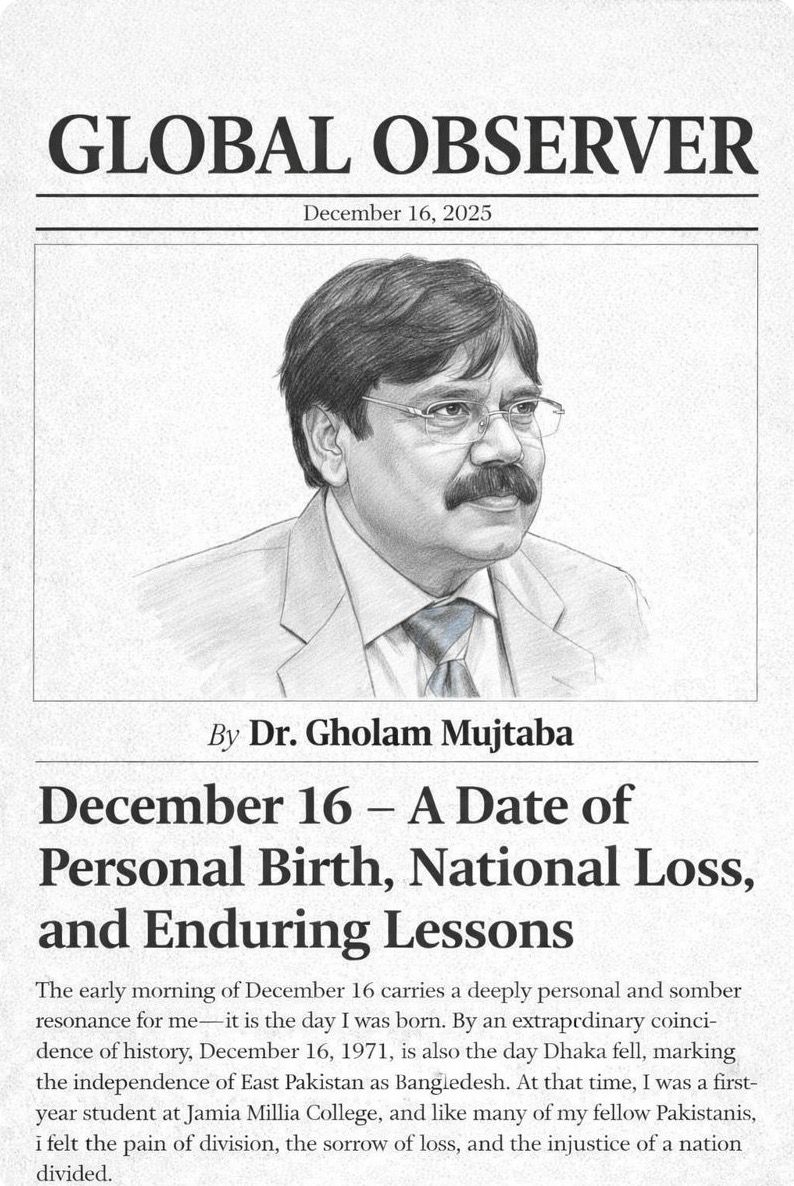
The early morning of Friday, December 16, holds a deeply personal meaning for me—it is the day I was born. By an extraordinary coincidence of history, December 16, 1971, is also the day Dhaka fell, marking East Pakistan’s independence as Bangladesh. At that time, I was a first-year student at Jamia Millia College. Llike countless young Pakistanis of my generation, I felt the pain of division, the shock of loss, and the sorrow of a nation fractured by political failure.
As a student and witness of history, I have seen what remains one of the most honest and credible elections in Pakistan’s history—the General Elections of 1970. Out of a total of 313 seats in the National Assembly (300 general seats and 13 reserved for women), the Awami League won 160 seats, securing an absolute majority based on its mandate from East Pakistan. The Pakistan Peoples Party won 81 seats, all from West Pakistan. Despite this unambiguous democratic verdict, power was not transferred to the majority party, and the National Assembly session was not convened in Dhaka, as requested by the elected leadership. This denial of a democratic mandate proved catastrophic.
These events reopened old wounds and echoed the painful memory of the 1952 Bengali Language Movement, when students—many of them young Bengalis—faced brutality for demanding linguistic dignity and recognition. They were told that Urdu alone would be Pakistan’s national language, despite the fact that Bengalis constituted the majority of the population. This stands in sharp contrast to neighboring India, which recognizes 22 scheduled national languages, including Urdu alongside Hindi—demonstrating that linguistic plurality need not threaten national unity.
History also records uncomfortable truths. In From Jinnah to Zia, Justice Muhammad Munir recounts that Field Marshal Ayub Khan once asked him to approach Huseyn Shaheed Suhrawardy in East Pakistan about the idea of separation. Suhrawardy, a committed patriot of Pakistan, firmly refused, asking Justice Munir to convey that if separation were ever contemplated, it should not be imposed on the eastern wing, which was in the majority. Such episodes reveal how political miscalculations and elite maneuvering steadily eroded trust between the two wings.
Yet history is not only written in bitterness—it is also written in human bonds that survive political collapse. In 2010, I visited Dhaka, nearly four decades after 1971. What I encountered was not resentment but love, warmth, and shared memory. My cadet college class fellow—Ambassador Tauheed Hosain, then serving as the Foreign Secretary of Bangladesh and today its Foreign Minister—received me with affection and sincerity, reflecting a bond that history could not erase. I was deeply moved when Prof. Dr. Sharif Ahmed Khan, an anesthesiologist at Rajshahi University, sang an Urdu song for me with tears in his eyes—a moment that transcended borders and spoke directly to our shared past. Another dear class fellow, Dr. Ulfat Hussain, and yet another, Brigadier General Ferdous Hassan Khan, spent nearly all their time with me during my stay, offering companionship that felt like family rather than formality. Seniors and juniors alike embraced me with affection. I had the honor of addressing Bangladesh Army officers and generals at the Army Mess, and I received a rousing welcome at my alma mater, Rajshahi Cadet College, where loyalty, respect, and shared sacrifice still live on both sides of history.
It must also be remembered that the Pakistan Movement was nourished by Bengali blood during the Bengal riots and by Bihari blood during the Bihar riots. Yet for political expediency, both communities were later denied equal rights. Even today, a significant population of migrants from East Pakistan—Urdu-speaking and Bengali alike—remains without full citizenship in Pakistan, lacking national identity cards despite more than five decades having passed and despite children born on Pakistani soil. This is deeply unjust, unheard of in the developed world, and profoundly troubling for a country that calls itself an Islamic Republic.
December 16 carries yet another tragic resonance in Pakistan’s history—the APS (Army Public School) massacre—a wound that still bleeds into the national conscience. As Pakistani Americans, we feel these losses keenly—losses born not merely of fate but of policy failures, partisan politics, and democratic derailment.
With honesty and balance, it must be said that the military sought to keep Pakistan united. Still, the political battlefield was lost because of misleading policies, power struggles, and the refusal by civilian leaders to honor democratic mandates. Nations are not broken by diversity; they are hurt by injustice and the denial of rights.
As Pakistan looks ahead, there is hope that clear-headed leadership will confront corruption, patronage, and partisan excess, restore citizenship rights, repair domestic policy failures, and strengthen democratic institutions. Pakistan is a nuclear state in a challenging region, capable of meeting external threats; it is the internal house that must be put in order.
On this December 16—a day of birth and bereavement, memory and resolve—let us commit to learning from history, not to relive it, but to correct it.