
Murad Shah approves `Master Plan’ for 75-acre Inclusive City Project to empower differently-abled persons
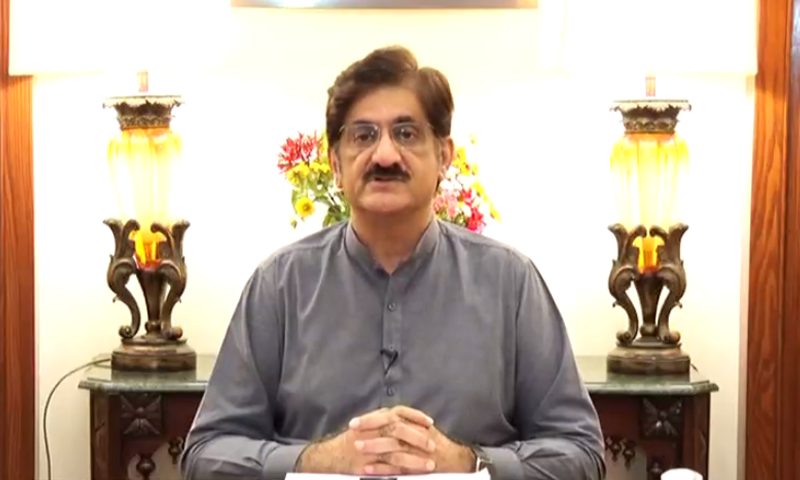
Syed Murad Ali shah,CM Sindh - FILE PHOTO
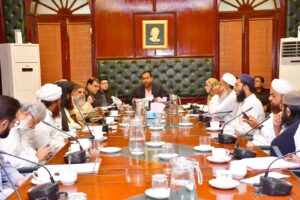
KARACHI (Oct 16): Sindh Chief Minister Syed Murad Ali Shah presided over a meeting of the Board of Directors of Inclusive City at the CM House, approving the project’s comprehensive Master Plan aimed at developing Pakistan’s first inclusive community model for people with disabilities and special needs.
The meeting was attended by Chief Secretary Asif Hyder Shah, Secretary to CM Raheem Shaikh, Secretary DEPDP Tauha Farooqi, Sultan Allana, Munir Kamal, Mervyn Lobo, Mushtaq Chhapra, Arshad Shahid Abdullah, Subia Sultana, and Farukh Mazhar.
The Chief Minister said the Inclusive City will serve as a model of accessibility, inclusion, and empowerment – providing healthcare, education, housing, and employment facilities for differently-abled persons. The project, being developed over 75 acres, reflects the Sindh government’s vision to create a barrier-free environment for all citizens.
Secretary DEPD Tauha Frooqui and Architect Shahid Abdullah briefed the chief minister about the project design and the facilities being developed there.
Project: The chief minister said that The Inclusive City will comprise residential blocks, an educational and training complex, rehabilitation facilities, NOWPDP spaces, inpatient and outpatient hospital blocks, NGO collaboration zones, clinical units, OPD and C-ARTS facilities, intensive outpatient blocks, and vocational centres.
The CM emphasised that the city would integrate inclusive education, therapy, vocational training, healthcare, and assisted living, ensuring holistic rehabilitation and mainstreaming of people with disabilities into society.
Mr Shah instructed the Secretary of DEPD to include a sports complex in the project, emphasising the need for recreational facilities to support the mental development of children facing various challenges.
Utility and Infrastructure: The meeting reviewed coordination with several departments and utilities, including PD Malir Expressway/BRT, NRL, KWSC, SSGC, SSWMB, K-Electric, PTCL, and KMC.
The CM was told that K-Electric (KE) informed that 4.9 MW of power will be provided through an 11KV dedicated, load-shedding-free feeder, similar to those serving hospitals in Karachi. KE also requested 60 feet horizontal and 20 feet vertical clearance from overhead transmission lines to ensure safety compliance.
SSGC confirmed its readiness to provide a single gas connection from Korangi Road, with pipelines to be extended parallel to the ring road and up to each building. However, the CM noted that LPG will be explored as a permanent, self-reliant alternative due to gas supply constraints.
KWSC briefed that there is currently no sewage line near the project area, and therefore Sewage Treatment Plants (STPs) will be installed to treat wastewater for irrigation. Treated black water will be safely discharged into the Malir River.
For potable water, since the nearest KWSC line (33-inch diameter) at Qayyumabad cannot meet project requirements, a Reverse Osmosis (RO) Plant will be installed on-site, the CM decided.
KMC reported that the nearest stormwater channel, Manzoor Colony drain, often overflows during heavy rains. Considering that the site is located on lower terrain, the CM approved an alternative plan with storm water recharge pits, reservoirs, and channels discharging into the Malir River, ensuring long-term flood resilience.
Project Progress: The boundary wall has been completed, while infrastructure works, including roads, stormwater, electrical, sewage, and gas systems, are expected to be completed within two months.
Phase I, to be executed within six months, includes Inpatient Hospital, OPD and Rehabilitation Units, Vocational & Inclusive Schools, Assisted Living/Transitional Housing Units and Staff Housing.
The CM directed all departments to fast-track coordination and resolve inter-agency issues to ensure the Inclusive City becomes a model of integrated planning and social inclusion.
Murad Shah said, “This is not just a development project, but it is a statement of equality, compassion, and dignity for every citizen of Sindh.”