National People Assembly Call for Economic Justice and Universal Social Protection
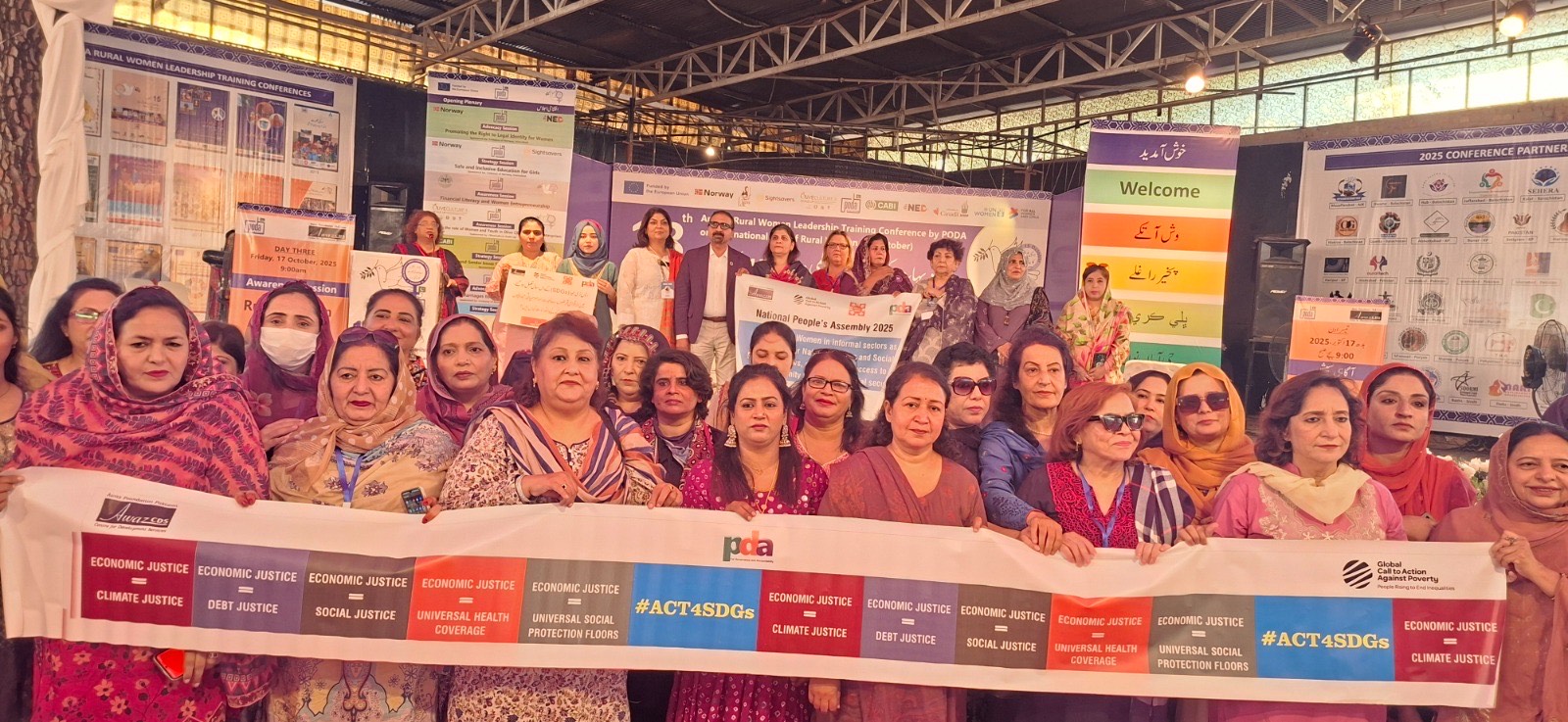
Islamabad, October , 2025 : To commemorate the International Day for the Eradication of Poverty, AwazCDS-Pakistan, in collaboration with PotoharOrganization for Development Advocacy (PODA), Pakistan Development Alliance (PDA and Global Call to Action against Poverty (GCAP) organized a National People’s Assemblyunder the aegis of Annual Rural Women Conference 2025 in Islamabad. The event brought together rural women leaders from across Pakistan, along with parliamentarians, media representatives, government officials, and civil society organizations. The Assembly served as a powerful platform for rural and informal women workers to voice their challenges, share their lived experiences, and collectively demand inclusive development and stronger social protection mechanisms.
Speaking at the Assembly, Mr. Zia-ur-Rehman, Chief Executive of AwazCDS-Pakistan and National Chair of the Pakistan Development Alliance (PDA), emphasized that poverty eradication cannot be achieved without structural reforms that prioritize the rights of informal women workers. He stressed the need for legal and policy reforms to formally recognize women in agriculture and home-based work as part of the national labour force, ensuring their entitlement to social security and fair wages. He also urged the government to expand and harmonize social protection programs across provinces to include all marginalized women workers under a unified, transparent, and politically neutral framework. Mr. Rehman further emphasized that provincial governments should institutionalize inclusive social dialogue by ensuring the representation of women workers in local governance structures, social protection boards, and policy forums.
The National People’s Assembly was further enriched by insights from distinguished speakers and experts. Ms. Daniela Draugelis, Founder and CEO of Cultural Pathways LLC, emphasized the importance of cultural empathy, inclusive leadership, and organizational adaptability in advancing gender equality and women’s empowerment. Ms. Gulmina Bilal Ahmad, Chairperson of the National Vocational & Technical Training Commission (NAVTTC) highlighted ongoing government initiatives aimed at expanding technical and vocational training opportunities for rural women and underlined the need to integrate gender-sensitive frameworks into national programs. Ms. Samina Naz, CEO of Talking Sense, also joined the panel and emphasized the crucial role of rural women in embracing emerging technologies and artificial intelligence (AI) to enhance future job prospects. She urged policymakers and civil society to ensure that rural women are equipped with digital literacy and AI-related skills, enabling them to participate in job market and secure sustainable livelihoods.
During the event, participants adopted the People’s Charter of Demands 2025, a unified national call for action in response to Pakistan’s growing economic inequalities, inflation-driven poverty, and lack of protection for women in the informal economy. The Charter highlights the urgent need for legal recognition of women working in agriculture, domestic work, home-based production, and daily wage labour as formal workers under national labour and social protection laws. It calls for fair living wages, safe and dignified working conditions, and robust measures to prevent workplace harassment and exploitation. The Charter also urges the expansion of social protection programs to include informal women workers, ensuring access to income security, disability benefits, and family support without political interference. It further demands universal health coverage, equitable access to maternal and mental health services, and gender-responsive budgeting to ensure women’s empowerment and livelihood enhancement.
Rural women participants shared heartfelt testimonies of economic hardship, unpaid labour, and exclusion from social protection schemes. AwazCDS-Pakistan and PODA reaffirmed their commitment to ensure the effective implementation of the People’s Charter of Demands and to amplify the voices of rural women in national and provincial policy dialogues, ensuring that no woman is left behind in Pakistan’s journey toward sustainable and equitable development.