
Privatisation to Improve Efficiency and Reduce Fiscal Burden, Says Muhammad Ali
Bids for three power distribution companies expected in early 2027; KATI leaders call for transparency, industrial reforms and private-sector participation
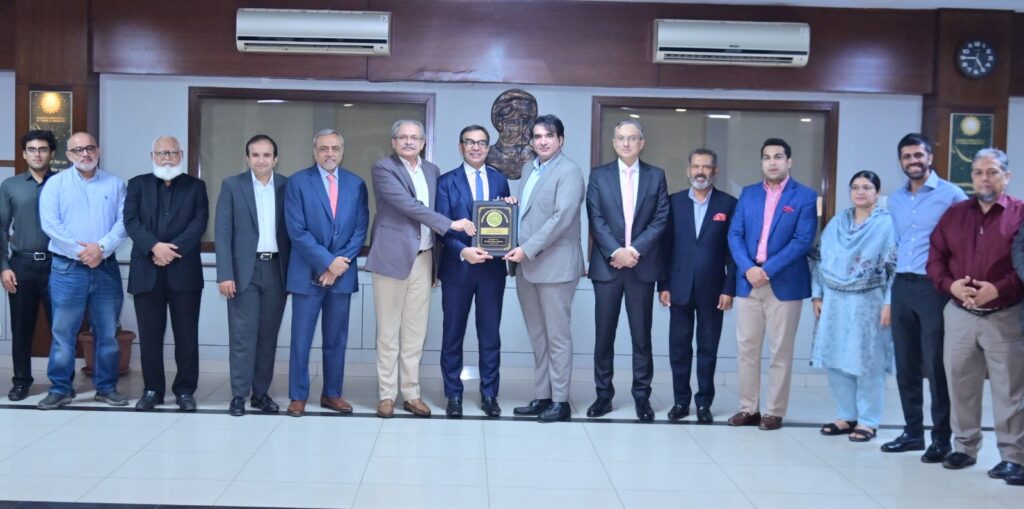
KATI leaders present a commemorative shield to Prime Minister’s Adviser on Privatisation Muhammad Ali.
Prime Minister’s Adviser on Privatisation Muhammad Ali has said privatisation aims to improve public-sector efficiency, reduce financial losses and ease pressure on the national exchequer.
He said the government wanted a transparent, merit-based process that served the national interest. It would also protect institutional capacity, employees’ legitimate rights and public services.
Muhammad Ali expressed these views during a visit to the Korangi Association of Trade and Industry (KATI).
The meeting was attended by KATI President Sheikh Umer Rehan, Deputy Patron-in-Chief Zubair Chhaya, Senior Vice President Farrukh Qandhari and Vice President Nasir Sheikh.
Former KATI chairmen Syed Johar Qandhari, Ehteshamuddin, Rehan Javed and Bashir Jan Muhammad also attended. Former NEPRA Chairman Tauseef H. Farooqi, industrialists and association members were present as well.
Bids for Three Power Distribution Companies Expected in 2027
Muhammad Ali said the government was working on 17 major privatisation projects. These include nine power distribution companies, three major airports, financial institutions and the insurance sector.
He cited the privatisation of Pakistan International Airlines (PIA) and First Women Bank as examples of progress through stakeholder cooperation.
He said due diligence for FESCO, GEPCO and IESCO was underway. The government expected to receive bids in the first quarter of 2027.
The privatisation of HESCO and SEPCO would follow in subsequent phases.
Pakistan Needs International-Standard Gemstone Laboratories to Boost Exports Mian Zahid Hussain
The government also plans to issue a Request for Proposals during the same quarter. The proposal will cover outsourcing operations at Islamabad International Airport.
Muhammad Ali further said two sections of the Hyderabad–Sukkur M-6 Motorway could attract around $700 million in combined investment.
These sections are Hyderabad–Tando Adam and Tando Adam–Nawabshah. Both projects are being structured under a 25-year concession model.
The government has also proposed $156 million in viability gap funding for the first section.
Business Certainty Essential to Attract Investment
Muhammad Ali said investors could assess risks and make decisions accordingly. However, uncertainty in the business environment remained a major obstacle to investment.
He stressed that bidders for power distribution companies needed clear information. This should cover future investment plans and multi-year tariff arrangements.
He also called for fundamental reforms in the energy and taxation sectors. These reforms, he said, were necessary to improve Pakistan’s industrial competitiveness.
Privatisation, market liberalisation, effective regulation and infrastructure investment should work together. Such measures could improve energy-sector performance while protecting consumers.
Similarly, a fair and stable taxation system would help businesses plan and invest over the long term.
KATI Calls for Transparent Privatisation
Earlier, KATI President Sheikh Umer Rehan said privatisation should go beyond transferring ownership to private investors.
Its main purpose, he said, should be to improve institutional performance, reduce losses and preserve the value of national assets.
He stressed that the process must follow transparency, merit and national-interest principles. It must also protect employees’ legitimate rights and public interests.
Sheikh Umer Rehan praised Muhammad Ali’s role in negotiations with independent power producers (IPPs).
He said revisions to power purchase agreements had helped prevent substantial future financial liabilities. The estimated savings of around Rs3,600 billion represented a major economic achievement.
He added that a strong economy required a strong industrial sector. Government and private-sector cooperation could create opportunities in investment, production, exports and employment.
The KATI president also called for expanding public-private partnerships across Sindh.
He said private investors should have opportunities to work on industrial infrastructure, roads, water supply, drainage, waste management, energy and transportation.
Such partnerships could reduce pressure on public resources and improve essential services.
Business Community Offers to Revive Pakistan Railways
KATI Deputy Patron-in-Chief Zubair Chhaya said Pakistan Railways had historically played an important role in the national economy. However, the institution now faced substantial financial losses.
He said the suspension of freight services had damaged both the railway system and the wider economy.
Chhaya urged the government to restore freight operations. Industrialists and exporters could then transport goods at lower costs.
He said rail freight could also reduce diesel import expenditure, road congestion and traffic accidents.
He proposed handing Pakistan Railways to private investors or industrialists. The business community, he said, could use its management expertise to make the institution profitable again.
Chhaya observed that successive governments had announced privatisation plans. However, he said tangible progress was now emerging under Muhammad Ali’s leadership.
He described the appointment of a technocrat to lead the process as a shift towards a more professional approach.
He also stressed the importance of political stability, policy continuity and good governance.
KATI Urges Independent Valuation and Strong Oversight
Former KATI chairman Rehan Javed said authorities should independently assess the assets, liabilities and market value of loss-making public-sector entities before privatisation.
He called for open and competitive bidding to select investors. He also stressed the need for effective post-privatisation monitoring.
Such oversight, he said, should ensure institutional performance, service quality and protection of public interests.
Javed added that the government and private sector could jointly develop basic infrastructure in industrial areas. These projects could support industrial activity, attract investment and create employment.