NASA’s Voyager 1 Reaches Historic One Light-Day Distance from Earth
The nearly 50-year-old spacecraft is now about 26 billion kilometres away, marking a milestone in humanity’s exploration of interstellar space.
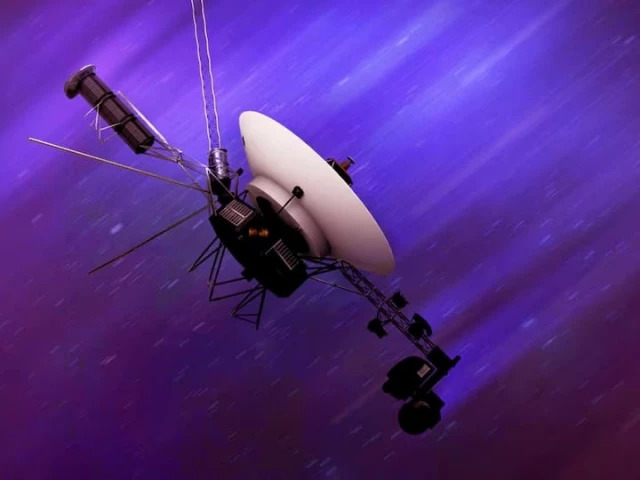
Voyager 1 reaches one light-day from Earth, marking a historic milestone in space exploration.
NASA’s Voyager 1 spacecraft has reached a historic milestone, travelling one light-day away from Earth nearly 50 years after its launch.
The US space agency said the probe was about 26 billion kilometres (16 billion miles) from Earth on Wednesday. A light-day represents the distance light travels in 24 hours.
Voyager 1 is already the most distant human-made object in space. Its latest milestone highlights the enormous distances involved in exploring beyond our solar system.
Tiffany Kataria of NASA described the achievement as a striking illustration of the scale of space.
“So much of what we dream about is travelling to other stellar systems,” she told AFP.
“And it took Voyager 1 nearly 50 years to get to just the edge of our own solar system, let alone to only a light-day.”
She noted that many planetary systems beyond our own are several light-years away.
Messages Now Take a Day to Reach Voyager 1
The spacecraft’s distance also creates a significant communication delay. Messages sent from Earth take about 24 hours to reach Voyager 1. Responses take roughly another 24 hours to return.
This means teams on the ground must wait around two days for a message-and-response exchange.
Nvidia Stops Shipping Licensed AI Chips to China Amid Export Uncertainty
Launched in 1977, Voyager 1 and its twin, Voyager 2, remain the only spacecraft to have entered interstellar space. This region lies beyond the boundary of our solar system, where both probes continue their exploration.
Golden Records Carry a Message from Earth
Both spacecraft carry Golden Records, gold-plated copper discs measuring 30 centimetres (12 inches) across.
Scientists designed the records to convey information about Earth and humanity to any extraterrestrial civilisation that might encounter them.
Over the decades, engineers have switched off some of Voyager 1’s equipment to conserve its limited power. Its cameras, for example, are no longer operating.
However, the spacecraft continues to study invisible features of interstellar space, including magnetic fields.
Kataria said its instruments collect valuable information about the gas, dust and other material between stars. Researchers use this data to improve their understanding of the space separating our Sun from other stars.
Voyager Missions Continue to Expand Scientific Knowledge
The Voyager spacecraft previously explored the outer solar system, including Jupiter, Saturn, Uranus and Neptune.
Voyager 1’s images of Jupiter revealed rings around the giant planet. They also helped scientists study its powerful atmospheric storms and weather systems.
The findings from both spacecraft have transformed scientific understanding of the outer planets and the region beyond the solar system.
Nearly five decades after leaving Earth, Voyager 1 continues to send back scientific data from a distance no other human-made spacecraft has reached.