

US-Canada Tariffs Push Trade Relations to New Breaking Point
Washington imposes 50% duties on selected Canadian imports as Mark Carney suspends negotiations and vows dollar-for-dollar retaliation.
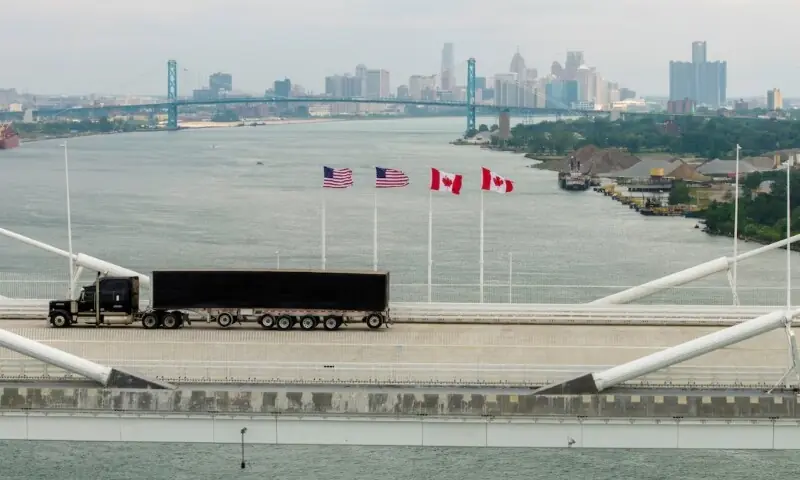
US-Canada trade tensions escalate after Washington imposes new tariffs on Canadian goods.
New Tariffs Target Canadian Imports
The United States has imposed 50% tariffs on a range of Canadian goods after Washington and Ottawa failed to reach a trade agreement, deepening tensions between two of North America’s closest economic partners.
The new duties took effect shortly after midnight on Saturday and apply to roughly $20 billion worth of Canadian goods entering the US. The affected products include items such as wooden hockey sticks and other imports that do not qualify for preferential treatment under the US-Mexico-Canada free trade agreement.
Although the targeted goods account for only a small portion of Canada’s exports to the United States, the move could have wider political and economic consequences. Canada sends the vast majority of its exports to the US, making the relationship particularly important for Canadian businesses and workers.
The latest measures have also raised concerns about the future of broader negotiations aimed at renewing the North American trade framework. The dispute could make those talks more complicated at a time when both countries are already dealing with tariffs affecting key industries.
Canada Suspends Trade Negotiations
Canadian Prime Minister Mark Carney said Ottawa had suspended negotiations with Washington after accusing the US administration of changing its proposed terms at the last minute.
Carney said Canadian negotiators had worked in good faith to protect the country’s interests but argued that the final US proposals were unfair and economically damaging. He also ordered Canada to respond to the new tariffs with equivalent measures.
“I have decided to suspend trade negotiations with the US,” Carney said, adding that Canada would retaliate “dollar for dollar” against the new duties.
Talks Collapse After Apparent Progress
The breakdown came after both sides had appeared close to an agreement. People familiar with the negotiations said a potential deal could have reduced tariffs affecting Canadian steel, aluminum and automobile exports while possibly allowing American alcohol products to return to Canadian liquor stores.
US Trade Representative Jamieson Greer blamed Canada for the failure to conclude an agreement, saying Ottawa had declined to finalise a deal based on terms discussed earlier in the week.
A senior Trump administration official said Washington’s proposal would have given Canada one of the most favourable tariff positions among major exporters to the US. The official said Canada had sought additional concessions involving steel, aluminum, automobiles and softwood lumber.
The White House indicated that no further negotiations were scheduled as the new duties came into force.
Wider Tariff Threats Raise Economic Concerns
The dispute follows President Donald Trump’s earlier threats to impose tariffs on a broader range of Canadian products. Those threats included duties on wine, furniture, dairy products, cement, clothing, fishing equipment and hockey-related goods.
For Canadian companies, the latest tariffs could increase costs and put pressure on industries that are already facing difficulties. Trade specialists have warned that vulnerable sectors could experience job losses, reduced investment and business closures if the measures remain in place for an extended period.
The new duties also come on top of existing US tariffs affecting Canadian steel, lumber and automobiles. Those sectors have already faced significant pressure over the past 18 months, although the economic impact has largely remained concentrated within the affected industries.
Uncertainty for Cross-Border Trade
The confrontation marks another serious test for the long-standing US-Canada economic relationship. With Canada preparing retaliatory measures and negotiations suspended, businesses on both sides of the border now face renewed uncertainty over the future of cross-border trade.